In December this year Killybegs will celebrate its 400th anniversary as a town. Local historian Pat Conaghan has made a lifelong study of Killybegs, and has written four books on local history. Here he outlines the process of creating a brand new town adjacent to the ancient Cealla Beaga at the beginning of the seventeenth century. This new town was never Na Cealla Beaga, which was the old monastic settlement on the south side of the harbour.
The Borough of Killybegs, 1615.
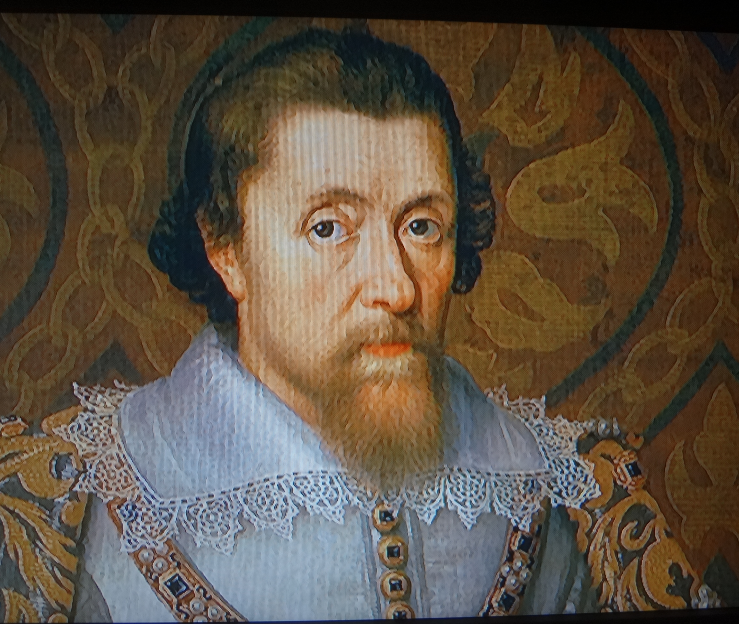
King James VI and I
The new town of Killybegs was founded by King James VI four hundred years ago. It was built on the north shore of the harbour, and came officially into existence on 14 December 1615 when it received its Charter.
Following the Battle of Kinsale in 1601-02 the British were free to overrun all of Ulster, right out to the western islands of Donegal. During the following decade they confiscated the lands belonging to the Donegal chieftains and allocated them to British settlers. Thus the Plantation of Ulster began. The Plantation scheme had three main objectives: One, to lock down Ulster because they believed O’Neill and O’Donnell, supported by Spanish forces, could regroup. If such an attack was planned, Killybegs would surely be chosen as the landing port. Two, to control and ‘civilise’ the ‘wild’ Irish. Three, to introduce the Protestant religion to the last unconquered Gaelic/Catholic region of Ireland. Also, the King, always short of funds, would be able to draw revenue from the conquered lands.
King James also had a political problem. He planned to hold a parliament in Dublin in 1613, but knew that his party was short of MPs. At that time he could create new MPs by setting up new towns, or corporations. Each town was entitled to send two members to parliament, and so the King ordered the creation of new towns in Donegal. These were Donegal, Ballyshanon, Lifford, and Killybegs, and St Johnston.
The towns were set up in strategic locations, where a castle or important pass already existed. Killybegs was chosen because of its strategic harbour and the McSwyne castle which stood on Castle Point. (Mooney Boats occupies this site). The British kept a small force of a constable and 20 soldiers in Killybegs in 1606 but it was thought they were vulnerable to attack. The Lord Deputy, Sir Arthur Chichester, recommended that a fort should be built at Killybegs, which would ‘resist great forces, and have a strong ward and much ordnance’. The Plantation had not begun, but it was time to make arrangements for the corporate towns to be set up.
Roger Jones, the Provost of Sligo, was tasked with building a new town within Killybegs harbour. Jones was a Devonshire wool merchant who had fought in Queen Elizabeth’s wars in Ireland, and who had made good in Sligo. He was granted a parcel of land within the harbour, and was instructed to build the town on that site. The instructions laid down nine or ten main conditions which Jones had to carry out:
One: To mark out an area of 224 acres for the town and its fields, or ‘parks’. The strip of land he chose lay northwards ‘across the water’ from the old settlement of Na Cealla Beaga. The new site extended from its western end at the Bridge River, for about two and a half miles eastwards. That eastern boundary is today the line between the townlands of Corporation and Straleeny. The strip of land was only about a half a mile wide, from the shoreline, and adjoining the townlands of Drumbeagh, Croaghlin, and Faiafannan. Jones paid the Treasury 24 shillings per year for this land.
Two: To lay out a town, with streets marked out ‘as well for defence as convenience’. Jones decided to build the town at the western end of the strip, that is, adjoining the Bridge River and the harbour, and extending eastwards to what is known today as ‘Mulreany’s Brae’.
Three: To build twenty houses of stone or timber, like the type of houses in England. He had to build five houses per year for the term of four years. He divided the site of the town into areas of one acre, which would contain a house and garden. These were called the ‘principal houses’ and each house was allocated two acres in the fields to the eastward of the town, for its hay and livestock.
Jones was instructed to allocate each of these houses to twenty persons of ‘civil education’ and could charge each tenant a rent of two shillings per annum.
Four: Set apart ten other acres for ten smaller houses, with one acre for each house. Rent for each house: One shilling and sixpence per annum.
Five: Provide a site for a Market House within the town.
Six: Provide a convenient site for a church and a cemetery, provided there was no church or cemetery already there.
Seven: Set apart 30 acres to be known as ‘the Burgesses Field’.
Eight: To set apart another area of 30 acres for the ‘Commons’ of the town, for the use of the official inhabitants. They would have this land in common, and rent-free.
Nine: Set apart two acres ‘lying in and near the said town’, for a school. Half an acre for the school site, and an acre and a half for a playground. Jones never built on this site, and it lay vacant until the first ‘Commons School’, then known as ‘Killybegs School’ was erected on it in 1834.
The Government of the town.
The committee or ‘corporation’ to run the new town consisted of a Provost and twelve burgesses. Roger Jones was appointed as the first Provost, firstly for a year, to be re-elected thereafter. The burgesses were hand-picked men who, with the Provost, would make up the legal entity called the Corporation of Killybegs. This entity, under English law, would be entitled to return two members to parliament.
The names of the first burgesses were: HENRY JOHNES, WILLIAM RASTOLE, EDWARD CARPENTER, RICHARD SMITH, JAMES MAIO, HENRY BLAGNE, WILLIAM LINCHE, FRANCIS BLAGNE, HENRY HARWOOD, THOMAS SMITH, RICHARD BAROWE, AND WILLIAM HOWELL. These officers have disappeared from history, seldom if ever making an appearance. Their sole function seems to have been to vote for the chosen candidate for MP from time to time. It is notable that each burgess was obliged to take the Oath of Supremacy, pledging his allegiance to the British monarch as head of the Church of England. This effectively excluded Catholics from holding the office of Provost or burgess.
It will be noticed that thirty houses were built although only thirteen possible ‘householders’ were mentioned. It is known that Jones owned one of the houses, and he probably lived there at times during the years of construction. Also, it cannot be denied that the burgesses lived in their new houses. Jones’s instructions allowed him to accept as tenants ‘cottiers and other inferior inhabitants’, so that he most likely found occupants for all of the houses.
Finally, the Corporation of Killybegs was granted several privileges, including:
A Court with jurisdiction to forty shillings, to be held regularly.
A Market every Tuesday and an annual fair to be held on Easter Monday. The British Exchequer to receive six shillings and eight pence annually from the market and fair.
The Corporation to appoint two sergeants at mace, and to have a common seal. The Corporation was also empowered to make bye-laws.
No retail sales were allowed within three miles on either side of the town, except by permission of the Corporation. This was to protect the monopoly of trade granted to the Provost and burgesses.
The politics of the town was soon taken over by the Conyngham family of Mountcharles and Slane, who controlled the political system and nominated the two candidates for parliament. It was easy for a wealthy ‘patron’ to influence the small number of voters in the Corporation.
The Corporation title is continued today in the official name of the townland of that name, which corresponds to the land that was granted to Roger Jones. The name Corporation appears in one other place in Killybegs, that is, on the tombstone of Paddy Finison, a former Provost, who died in 1703. A piece of doggerel verse on his headstone reads:
HERE IN THIS TOMB A PROVOST LIES
THAT WAS BOTH PIOUS JUST AND WISE.
HE WAS BOTH PLEASANT AND SINCERE
THE GOOD HIM LOVED THE BAD DID FEAR.
AND WHEN HIS TIME WITH YEARS WAS SPENT
THE CORPORATION DID LAMENT
The Corporation of Killybegs, if it was still in existence, came to an end on January 1, 1801, with the union of Britain and Ireland. A commission in 1834, visiting Killybegs, found that there was no memory of the old Corporation.
 killybegsbooks