
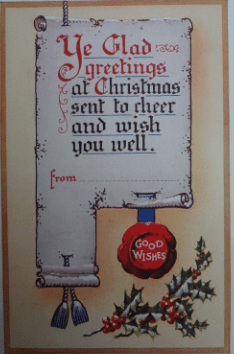
Happy Christmas to all my readers at home (and world-wide!)
Happy Christmas to all my readers at home (and world-wide!)
HOW WE PASSED THE TIME
In the dark ages, when this blogger was a lad, say, the early 1950s, we had to amuse ourselves while waiting for the iPhones to be invented. In the winter evenings we hung around the town, and got up to devilment to ease the boredom. Being super intelligent, we thought it was great fun to knock on doors and run away before the door was opened. (Front doors had heavy knockers then). The prank would be repeated on the same door if you knew the occupant took it badly. On the third assault on the same door, you just knew the householder was waiting inside the door with a stick. Exciting! We made a big ‘improvement’ on the knocking method by getting a spool of thread and tying the end to the knocker. That way, we could bang the knocker from a safe distance, and watch the puzzled householder come out and look up and down the street. But we left it at that. A report from 1923 shows that the lads of that time took their ‘fun’ more seriously, as the account below shows:
KNOCKER-WRENCHING AT KILLYBEGS.
Hallowe’en, was formerly the night on which stupid and very often destructive tricks were played on by unthinking youths but the date for such doings has been changed, in Killybegs at least, to, of all days in the year, Christmas Day. On Christmas Eve, or early on Christmas morning, the inoffensive knockers on the doors of 16 houses were wrenched off or broken, only a few, for obvious reasons, being left untouched. The culprits were not ‘kids’ certainly, as the operation required both strength and skill. Nor was it the work of the ordinary corner boys, though the perpetrators, generally suspected by their brainless and possibly drunken folly, proved themselves worse than the corner boy by stooping to such vandalism on such a sacred festival.
(31 January 1923)
As they say, ‘Don’t try this at home’ – or anywhere else.
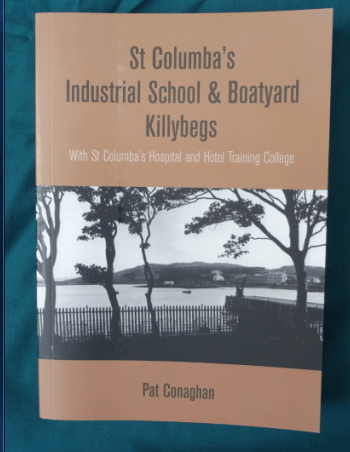
You couldn’t get a better present than this. Available at the Killybegs Information Centre on Shore Road, Four Masters Bookshop, Donegal, Eason’s, Letterkenny.
It is already known that the new town of Killybegs was founded by Charter of King James VI, dated 14th December 1615, in the 13th year of his reign.
The man chosen to build the new town was Roger Jones, then Sheriff of Sligo. Jones was a wealthy merchant and he was ordered to finance and oversee the building of the first houses in new Killybegs. The plan was that the king, who was always strapped for cash, did not have to spend anything on this new settlement. The town was managed by Jones and a group of picked gentlemen, who set themselves up as the Provost and Corporation of Killybegs, thereby giving (English)) legal status to the town. Jones was made Provost, and it is known that he occupied one of the first houses, although the site has not yet been identified. Jones had been granted a narrow plot of land for the town, adjoining the north shore of Killybegs harbour. This site extended from the ‘Bridge River’ eastward to the second by-road beyond the Commons School. A dispute over the ownership of this land meant that Jones departed Killybegs some years later, and he died in Sligo in 1637.
He was buried in St John’s Abbey, Sligo, and an elaborate gravestone, depicting Lady Jones and himself, was placed on his grave. Unfortunately the graveslab was badly damaged at a later date, and part of Jones’s image was lost. The fragmented stone is located today in the Cathedral of St Mary the Virgin and St John The Baptist, in Sligo.
While Jones, through his business interests, helped to establish Sligo town as a large trading centre, he appears to have had no influence on the development of Killybegs.
The priceless assets of a deep-water harbour and an abundance of fish were exploited by foreigners who used Killybegs as a base for fishing and processing. Government agencies such as the CDB, SFA, BIM and the IDA, supported the development of the industry for most of the 20th century. But it was not until private investors took control of the economics of the industry that the prosperous town of Killybegs emerged from the industrial darkness of the North West.
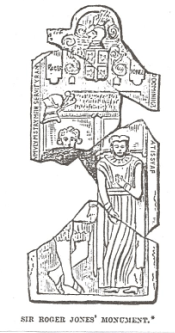
THE BROKEN GRAVE-STONE DEPICTING ROGER JONES AND HIS LADY.
It would be appropriate if a memorial to Roger Jones were to be commissioned and erected in Killybegs at this time, using a modified version of the above stone.
TOURISM
An article in the Press in 1929 described Killybegs as a great tourist destination. One of the sights to be seen, it was said, was the Rocking Stone in Faiafannon:
The Rocking Stone of Faiafannon, about two miles from the town, should not be missed. The huge stone, delicately poised on a rock, is capable of being moved without the slightest danger of being disturbed from its resting place. Strangers may have difficulty in providing the motion, but those who are familiar with the stone usually succeed in producing the swaying movement which gives it its name.
During the depression years of the late 1930s there was very little employment in Donegal. Work was created by the Government via Minor Relief Schemes, for example, the opening of extra roads in country areas, or repairing roads that did not really need much repair. One such scheme was started in the townland of Faiafannon, where, in November 1938, thirty men were provided with work, under the supervision of John McBrearty, Island. The purpose of the scheme was to build a new road to the Rocking Stone, or Wishing Stone, as some called it. Killybegs folklore stated that Finn McCool threw this rock from Connaught, although what made him so mad is not recorded. The new road was completed just before Christmas in that year, the scheme providing many households with badly-needed cash during the darkest time of the year.
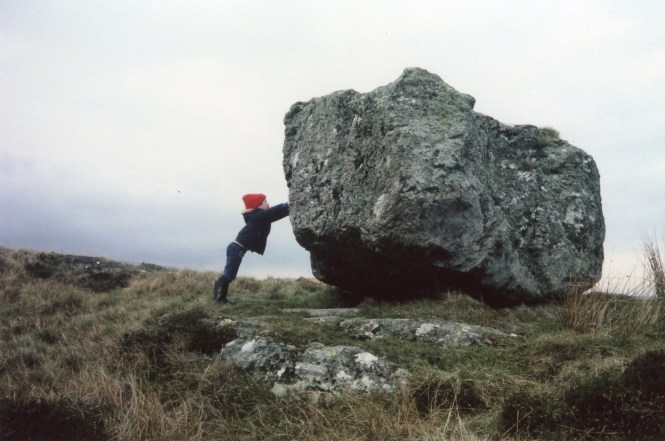
The Rocking Stone at Faiafannan, Killybegs.
 killybegsbooks
You must be logged in to post a comment.