
It is already known that the new town of Killybegs was founded by Charter of King James VI, dated 14th December 1615, in the 13th year of his reign.
The man chosen to build the new town was Roger Jones, then Sheriff of Sligo. Jones was a wealthy merchant and he was ordered to finance and oversee the building of the first houses in new Killybegs. The plan was that the king, who was always strapped for cash, did not have to spend anything on this new settlement. The town was managed by Jones and a group of picked gentlemen, who set themselves up as the Provost and Corporation of Killybegs, thereby giving (English)) legal status to the town. Jones was made Provost, and it is known that he occupied one of the first houses, although the site has not yet been identified. Jones had been granted a narrow plot of land for the town, adjoining the north shore of Killybegs harbour. This site extended from the ‘Bridge River’ eastward to the second by-road beyond the Commons School. A dispute over the ownership of this land meant that Jones departed Killybegs some years later, and he died in Sligo in 1637.
He was buried in St John’s Abbey, Sligo, and an elaborate gravestone, depicting Lady Jones and himself, was placed on his grave. Unfortunately the graveslab was badly damaged at a later date, and part of Jones’s image was lost. The fragmented stone is located today in the Cathedral of St Mary the Virgin and St John The Baptist, in Sligo.
While Jones, through his business interests, helped to establish Sligo town as a large trading centre, he appears to have had no influence on the development of Killybegs.
The priceless assets of a deep-water harbour and an abundance of fish were exploited by foreigners who used Killybegs as a base for fishing and processing. Government agencies such as the CDB, SFA, BIM and the IDA, supported the development of the industry for most of the 20th century. But it was not until private investors took control of the economics of the industry that the prosperous town of Killybegs emerged from the industrial darkness of the North West.
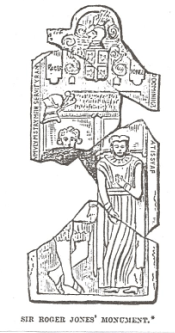
THE BROKEN GRAVE-STONE DEPICTING ROGER JONES AND HIS LADY.
It would be appropriate if a memorial to Roger Jones were to be commissioned and erected in Killybegs at this time, using a modified version of the above stone.
 killybegsbooks
This is a fascinating piece of Killybegs history & not a lot of people are aware of it… please share it on a place of promince in the town, i.e. Johnny Cunninghams shop window or. on a special piece of commissioned stonework….. & let tourists & also locals etc be aware of this astonishing piece of history…Mary Dorrian
LikeLike