
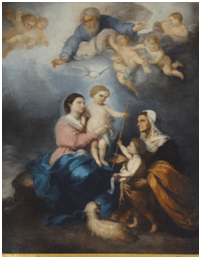
In the old days distinguished people came to Killybegs to see the tomb slab of Niall Mor McSwyne and a 17th century painting of the Holy Family in St Mary’s church. Now the church has a new attraction in the form of the restored painting. It is in the style of the famous Spanish artist, Murillo, although not by the master himself. The restored painting was unveiled in a special ceremony on Friday 16th October, 2015. The original work by Murillo is in the possession of the Louvre in Paris, where it is titled The Holy Family, or The Virgin of Seville.
The Killybegs painting was presented to Father Drummond for his new church in Killybegs at some time in 1844 by Alexander Murray, the most extensive landlord in the district.
The story of the picture that has come down to us is very sketchy, but its time in Killybegs can be reconstructed.
Murillo’s large religious paintings were intended to be hung in churches or in the palaces of Bishops, so the Killybegs copy was painted for the same reason.
Apparently Murray bought the painting in London for 200 guineas, and sent it to Dr Drummond who hung it in the newly built church. It appears that everyone, including Murray, knew that the painting was executed by someone other than the master himself, and from that time at least there was no question of anyone being deceived. Landlords in Ireland have had a very bad press, but, in Murray, Killybegs surely had one of the best. This article is too short to list all his contributions to Killybegs, but it must be said that he provided the site for St Mary’s (and St John’s) church, as well as a donation of £100 towards its construction. The Mulreany family used to cut the hay on this site but it is likely that Murray provided them with another piece of ground. Murray was well known as a collector of art, and it is curious that he should have paid such a large sum for a painting that was not an original Murillo. No doubt Father Drummond was delighted at such an impressive gift for his new church. But how much more pleased would he have been if Murray had sent him 200 guineas in cash? Especially so because Dr Drummond had to travel to America to raise the money to complete the church. (From the Irish community there, and not by singing on street corners, I beg your pardon). Dr Drummond went across the Atlantic in the Paddle-steamer, Britannia, that carried the ship’s cow in a deckhouse.
Not having access to the finding aids of today, Dr Drummond and his advisors interpreted the painting as The Visitation, and named the new church accordingly. By 1856 Dr Drummond’s former Curate, Father James Stephens, then parish priest of Taughboyne, was still calling the painting The Visitation of the Blessed Virgin. The painting depicts St Elizabeth and John the Baptist paying homage to the Child Jesus and Mary, His mother, so his early title was descriptive enough.
It was not until he returned to Killybegs as parish priest that Father Stephens stumbled on the ‘correct’ title of the picture. In 1867 he decided to erect, within the church, memorials to Bishop Donald McGonagle, and to Dr Drummond, the church’s founder. He erected a stone tablet on the wall near where Dr Drummond’s remains lie (unmarked), and installed a stained glass image in one of the triplet windows over the high altar. This was a representation of St Catherine of Siena, to whom Dr Drummond was especially devoted. At that time the Murillo painting was hanging on the chancel wall, over the high altar, and it was taken down to facilitate the work on the St Catherine of Siena window. Apparently the picture was then in poor condition because Father Stephens sent it off to Lesage’s in Dublin to be restored. Among those who were publicly acknowledged as having contributed (usually £1) to the restoration fund were the Right Hon. Chief Justice Monahan, Joseph Woodstock, Dublin, Simon Sheil, M.D., Ballyshannon, and Patrick Donnelly of Omagh. Donnelly’s wife was Ellen Coane of Coane’s Hotel, Killybegs, now the Cope House. The Coanes were closely involved in parish affairs at that time, and it was most likely that it was Ellen who prompted the donation. In the 1940s Ellen’s son, Alex Donnelly, a solicitor by profession, kept the old Hotel going during its last years in the family.
The restored painting arrived back in Killybegs at the end of 1867. Father Stephens invited the Very Rev James McDevitt, Professor of Philosophy at All Hallows college, to give the sermon at a special Mass on December 22nd to mark the occasion. Dr McDevitt would go on to be consecrated Bishop of Raphoe in 1871.
Among the distinguished visitors to Killybegs who went to see the painting in 1880 was Hugh Childers, the British Secretary for War. He was received by Father Stephens in the old parochial house on Chapel Lane, in September of that year. After their discussion, Childers, with his wife and daughter, viewed the interior of St Mary’s, and were particularly struck with the splendid painting of the Holy Family. It is interesting that Childers’ daughter, Milly, then only 14, later became a painter of church interiors, copyist and restorer.
Canon John Sweeney had the church renovated when he was P.P., when the painting was probably taken down, at least for a time. Then, in May 1936 work on the repair of the ceiling of St Mary’s was begun, and it is likely that this was the time when it was put into storage for the last time.
So, just like the old days when tourists came to see both the grave slab of Niall Mor and the ‘Murillo’ painting, they can be seen once more.
 killybegsbooks