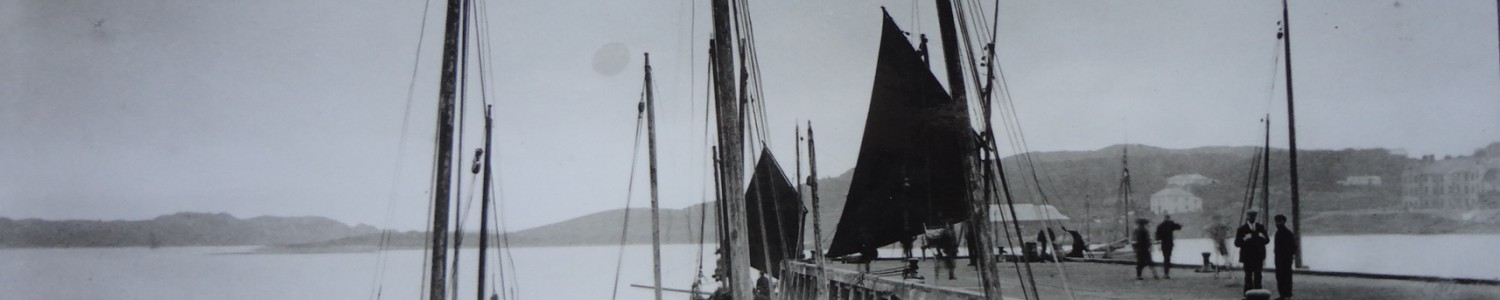
‘A drive of three miles from Ballyshannon took us to Bunatroohan, a small fishing station on Donegal Bay, where we were to embark in a stout open boat for Killybegs. The little fishing community at Bunatroohan possesses about six boats, the owners of which are hardy and industrious men. They are sadly in want of a quay, the building of which would cost scarcely £100. At 6.30 we boarded the boat with the owner and two men. We had three oars and a mast, which could be hoisted in case a breeze sprang up, as it did before we were long out. It took us two hours and a half to cross the bay to the lighthouse at St John’s Point, to reach and cross another and smaller bay, named McSwyne’s.
This narrows into a noble waterway a mile in length and as straight as Sackville Street, at the head of which nestles Killybegs, under the shadow of its mountains. An object of interest was a whale, which followed us a couple of hundred yards off for half an hour, showing in its gambols every now and then its black back, about twenty feet long, above the sea. On nearing St John’s point we observed that the tip of the peninsula is really an island, separated from the rest of the promontory by a channel of about thirty or forty yards. At first we thought of shortening the journey by running through this channel, but the rush and roar of the waters in it and the height to which the foam was dashed against the rocks deterred us from the attempt. We gave it a wide berth accordingly, and rounded the island into McSwyne’s Bay at the head of which, some five or six miles distant, we saw a glimmer of the lighthouse that was out guide into Killybegs. Some sunken rocks lay straight in our course, and manifested their presence by rolling up the elsewhere smooth waters into an angry heap, and sending them furiously scudding eastward half in foam, to the promontory which we desired to skirt. The foam was lifted far higher than our mast, and was driven with a force which would have instantly capsized any small vessel in its way. We bore away, therefore, to the west, and gave our dangerous friend a wide offing.
By and bye, it became necessary to alter our course from west to north, and as the slight breeze was nearly in our teeth, we took down our mast and threw new energy into the rowing. Night fell, and we spent a tiresome two hours more in pulling up to the second lighthouse, from which our run home into the little harbour of Killybegs was comparatively easy. We were very cold and cramped on climbing the quay, but half an hour’s drying at the kitchen fire of the hotel and a refreshing wash-up sent us with hearty appetites to the excellent supper prepared for us by Mrs Rogers. Killybegs is at once wild and cosy. You feel yourself free from all the trammels of gentility, without falling into any of the discomforts of barbarism. The scenery is charming. In front of your hotel, a long water-lane, ending in the Atlantic. A few small craft in the harbour – one of them has brought sawn planks from Sligo, another coal from England, and the rest look like pleasure boats. There are a couple of hundred houses, small, but substantially built, and most of them neat in aspect. At the left, as you face the sea, rises the square tower of the Catholic Church, which dominates the straggling little town, and is a fine object of view from sea and land.
It contains a large and excellent replica of Murillo’s Holy Family, presented by a former lord of the soil, and recently well restored by Mr Lesage, of Sackville Street. There are other interesting monuments in the Church, which the visitor will do well to study with the aid of the Illustrated Hand book of South-Western Donegal, published in 1872 by McGlashan and Gill. Killybegs is, par excellence, a watering place for a family of boys and girls. There are no bathing boxes for the latter, but there are plenty of nooks at a little distance from the town where a modest maiden can prepare for her bath, and the boys can have ‘headers’ into deep water at many still more convenient points.
I spent an hour inquiring into the rent of houses and cost of living. You can get a very fair cottage with a sitting room and three bedrooms for £10 a year, unfurnished, or for £20 furnished. There are plenty of delightful sites which you could get for a nominal sum, and build on at your own discretion, and thus possess a perpetual refuge in the hot summer months, for a sum which would only pay for equal accommodation for a single season at Southport or Brighton. Butchers’ meat, milk, and butter are about seven tenths of Dublin prices, and boats and donkeys are to be bought or hired at very moderate rates.
- There are no social amusements, but there is plenty of fishing with long lines and with the rod, and there are endless excursions within easy reach by land and water. If the excellent hotel had a billiard table it would pay, and be a great resource. The post car leaves for Carrick at 1 p.m., and today it started with a companion vehicle and some emigrants, whose relatives bid them adieu with all the lamentations usual on such occasions. A couple of hours afterwards our party started, not without regret, and after a three hours’ drive up hill and down [dale] and through half a dozen villages unknown to fame, drew up at the handsome and comfortable Glencolumkill Hotel of Carrick. The day was very hot for Ireland – 78 in the shade, I was told – and a tub was most acceptable before dinner, which consisted of half a magnificent salmon, a tiny roast leg of delicious mutton, good new potatoes, without other vegetables, a pudding, and some really excellent claret, at 3s 3d a bottle’.
 killybegsbooks