Poem (3)

This is a very sad poem. Casimir MacGinley, son of Thomas Colin and Margaret T. Sinnott, was born in Croagh in 1873. He attended the local school where his father taught, and afterwards attended College in Letterkenny, where he was considered a very good scholar.  From the age of 17 however, his eyesight began to deteriorate, and by the age of 24 he was losing the sight of both eyes.  In this condition he lived with his parents in the newly-built Sea Bank Cottage (later named Bruach na Mara) in Killybegs.  The late Bella McGee New Row, Killybegs, remembered him being assisted up the centre aisle of St Mary’s church, Killybegs.  He was a brother of Bishop John B. MacGinley.  Casimir died on 4th July 1940 at the age of 67.

DARKNESS AND LIGHT.

Shadows have gathered o’er me

While the day has but begun;

Dark is the way before me,

Eclipsed is the morning sun.

Colour and light and shining

Have gone with the glad, sweet day,

Sorrow and sad repining

Have come on my gloomy day.


Dark is my cloud, but shining

Beneath it I yet can see

The light of silver lining-

Sweet shining with hope on me.

And through the darkness gleaming

Comes a heavenly radiant light,

With smiles upon me beaming,

And guiding me through the night.


It is the lamp, brightly burning,

That lighteth me through the night,

Of hope of sight returning

In Heaven’s eternal light.

Shadows have gathered o’er me,

But the light of hope has shone;

Dark though the way before me,

Hope’s beacon light leads me on.

 (T. MacG., Killybegs, September 6, 1897).

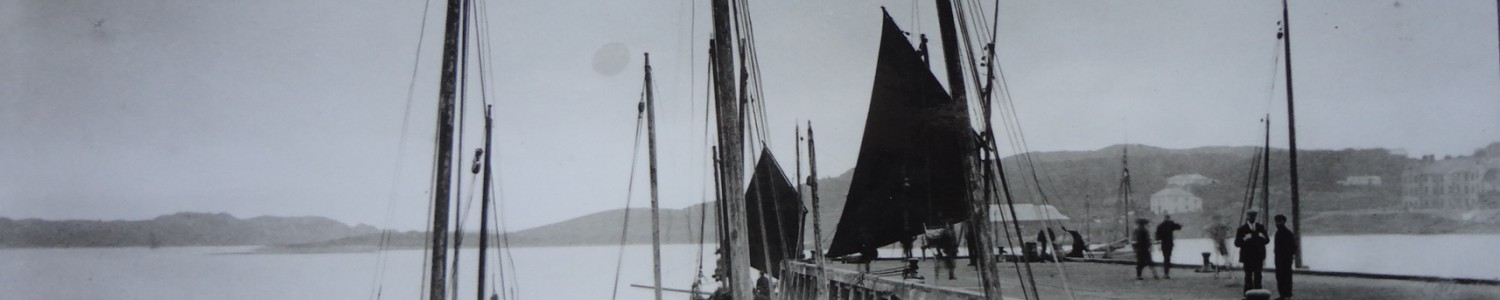
The Rosses Fleet 1898-1914

From 1895 the Congested Districts Board began to issue ‘deep sea’ boats to fishermen on the west coast of Ireland. These sailing boats, Nobbies and Zulus, would be a big step up from the traditional yawls of about 26ft in length.  The CDB went on to provide a whole new fleet of sea-going vessels, with Donegal benefiting the most from this massive project.  It was the intention of the CDB to transform the existing part time fishermen-farmers, and especially farmers’ sons, into full time fishermen.   To this end they hired a number of experienced Scottish fishermen and put them on the new Irish boats to instruct the local men in all aspects of gear and fishing.  The CDB also made sure there was a market for all fish caught, without which the whole scheme would have failed.  Finally they brought in foreign curers and coopers to show the locals the best methods.

Below is a list of the CDB boats which were allocated to the Rosses, by year of allocation. A few in the list were bought directly by Rosses men, but most were placed with crews by the CDB.  Those marked * are motor boats (having an engine from new), and + indicates Steam drifters.  The majority are Zulus, with a few Nobbies, and some of these were engined later.

St Bernard 1898

St Michael 1898

Lord Finross 1899

St Connell 1903

St Mark 1903

Errigal 1903

Star of the Sea 1905

Glen Head 1905

St Aiden 1905

St Eunan II 1905

St Ita 1906

Teelin Head 1906

St Colman 1907

St Paul 1908

St Finan II 1908

Fair Head 1908

Countess Grosvenor 1909

St Patrick II 1909

Enterprise 1909

Downings Bay 1909

Aztec 1910*

St Marcellinus 1911

St Gerard Majella 1911

Fishers Friend 1912

Vine 1912*

Foxglove 1912

St Finbar 1913*

Daylight Star 1913*

Summer Star 1913*

Inishirrer 1912-13+

Gweedore 1912-13+

Gola 1914*

Morning Star*

Calistoga 1915+

Emerald 1915

Catch-Me-If-You-Can 1916

Cnoc an Duin

Flora Campbell 1914.

(Source: The Zulu Fishermen by Pat Conaghan, 2003)

Sea Stories (3)

THE YELLOW BANK.

Glencolumbkille, May 29th, 1867.  There is a shallow or sand bank lying about thirty or thirty-five miles in a north-west direction from Ross Eoaghan Head, the most westerly point in the County Donegal.  It is called the Banc Buidh, yellow bank, and is said to be thirty miles long and four miles broad.  Tradition represents the place as teeming with fish, both ling and cod, but owing to the unsuitableness of the small fishing craft employed about here, the fishermen, hardy and adventurous as they are, dare not venture so far from land.  The only visits paid to the bank within the last eighty years by an inhabitant of these places were two.  Neal McShane, of Malinbeg, lately deceased, was taken as pilot on board a Dutch galliot bound for Sligo.  The wind proving treacherous, the vessel was driven out of her course, and tossed about for six days.  On the morning of the seventh day the wind abated, and was followed by such a calm as left the vessel without motion.  McShane, knowing from certain landmarks that they were on the Banc Buidh, got a cod line and baited it with a piece of fish.  The bait had not time to touch the bottom till the experiment proved successful, and McShane had the satisfaction of hauling in a fine cod.  This he repeated with like success for eighteen consecutive shots when, a breeze springing up, he had to yield, reluctantly however, to the entreaties of the captain, and bid good bye to the Banc Buidh, as it happened, forever.  John Haughey of Teelin visited the bank about twenty years ago as skipper of a smack belonging to as Scotch fishing company.  The smack, manned by seven men, left Malinbeg early on a July morning, and reached the bank about eight o’clock, a.m., same day.  They immediately shot their seven baskets of long-lines.  Each man had from 120 to 180 hooks attached to it.  They were not long on the bank till the day began to grow stormy, so that they were compelled to commence hauling the lines.  Short as was the time on the bank, each hook had its fish, and three of the baskets were sufficient to fill the boat which was capable of holding five tons weight, and the fishers were obliged to leave the remaining baskets.  The depth of water on the bank varies from fifteen to fifty fathoms.  There are fishermen enough in Malinbeg and Malinmore, Teelin, etc., but then their boats of 26 feet keel are quite too small for deep sea fishing.  It would pay the North-west of Donegal Fishery Company if they could send a few of their larger vessels round here.  There is an excellent boat port at Malinbeg for small boats, but capable of great improvement.  There is also a good port in Teelin, and then the safe and commodious harbour of Killybegs is only ten of eleven miles from Malinbeg.  Sunfish come in great numbers to these coasts in the months of June, July and August, and their visits might be easily turned to profitable account if the proper means of following the fishery were at hand.-

Feis Winners.

Supt. Tom Martin, Killybegs, added laurels to his reputation as a tutor of Irish singing and dancing, when on Sunday, 28th August, 1938 at Templeboy Feis, (Sligo), the Killybegs troupe, all of which he had under his supervision, won first prizes.  They were Miss Sarah Gallagher, Miss Lena Cunningham, Miss Maire Molloy, Miss Nellie Hegarty, Master Donald Martin, and Master Frankie Rogers (fairy reel).  Mr Charles McCahill, Fintra (traditional Irish airs on fiddle); Master Donald Martin (Irish singing).  The adjudicator was high in his praise of the display given by the Killybegs troupe, and commended Mr McCahill for his beautiful rendition of Irish traditional music

Sea Stories (2)

Four Drowned at Inver.

On Monday, 5th December 1836, four very decent men went out in an open boat to fish in Inver Bay.  They were not long out when a storm arose and upset the boat.  They clung to the keel, and soon righted her, but a heavy sea breaking over them, they were swamped, and instantly perished.  Three of them were soon afterwards washed on shore, but the fourth was not found immediately.  They were all married, and left wives and families to lament their untimely deaths.  They bore excellent characters, and were deeply lamented by their neighbours.

Mistakes & Omissions (7)

Report from Killybegs Petty Sessions Court, 14 August 1899.

Complainant: Catherine Campbell, Killybegs.

Defendant: M. F. (A female).

CHARGE: The Defendant, at Killybegs on the 24th day of July 1899 did unlawfully steal take and carry away one belt, value for eight pence, and three shillings and sixpence [cash], the goods and monies of one Catherine Campbell from her shop in Killybegs, and had said belt in her possession at Killybegs on 24th July 1899, knowing the same to be stolen or unlawfully come by.

Defendant was ordered to be sent to St Catherine’s Industrial School at Strabane, to be detained there until the 14th day of August 1904, her age being ascertained to be 11 years and her religion being that of Roman Catholic, she being charged with an offence punishable by imprisonment, she should be dealt with under Section 13 of 31 Vict. Chap 25.

Mistakes & Omissions (6)

Sentenced for Begging.

DONEGAL PETTY SESSIONS.

The above Court was held on Wednesday, 22nd October 1902, before Captain Crosbie, R.M., (Fintra House), Captain J. S. Hamilton, James Timoney and G. E. B. Bevan, magistrates.

Mr James Dunlevy, solicitor, Donegal, applied on behalf of the Right Rev Monsignor McFadden, P.P., V.G., Donegal, and Dean of Raphoe, to have three little girls who were begging from house to house sent to St Catherine’s Industrial School, Strabane, and a little boy, who was also begging, sent to Killybegs Industrial School.

The magistrates, having consulted, made the order sought.

Near Miss (4)

A plucky rescue took place near Killybegs pier in October 1941 when one of a crowd of youngsters fishing sheans with lines, overbalanced and fell into the water. The greatest praise is due to eight-years-old Charles McGowan, The Cottages, who succeeded in hauling the boy, nine-years-old Tommy Kyles, of Bridge Street, into the boat again.

Census 2016.

Mary came round with the Census forms last week. Not easy reading. If you get a shot of indigestion, don’t worry, that’s the effect it has. Then, all of a sudden there’s a flash of comedy – didn’t know the CSO was into stand-up:

Question 13.

How many children have you given birth to?

This question is for women only.   (!!!!!)

Near Miss (3)

FUNERAL PARTY ESCAPE DROWNING.

The Arranmore Disaster of November 1935 has been well documented, and indeed was a terrible tragedy.  Six years earlier, a catastrophe of similar dimensions almost happened to the inhabitants of a neighbouring small island, Inishfree.

On Christmas Eve, 1929, a funeral party was making the passage from Innisfree Island to the mainland near Dungloe. The remains of the deceased, Mr Hugh O’Donnell, were being ferried in the leading boat, which was skippered by his son, Jim.  The next boat following at a distance of half a mile, was packed with twenty-six mourners including six or seven women, and was skippered by James O’Donnell.

The two boats had left the island, the first containing the coffin and eighteen mourners. On account of the strong southerly gale the second boat was driven a little off course, and when it struck a rock, a hole ten feet in length was ripped in the hull.  The boat immediately filled with water and sank beneath her crew.  With no time for preparation, the twenty-six occupants were left to their fate in the water.  Fortunately, a number of them were good swimmers, and the stronger of the men swimmers tried to hold up their weaker companions.  The severe cold of the water and shock took effect, and many struggled to survive.

Jim O’Donnell later recounted the events: ‘Someone shouted: Oh my God, the other boat is sunk! I was at the helm, and looked back and saw what I first took to be a flock of cormorants on the surface of the water.  But what I saw were the passengers of the boat, bobbing in the sea’.

Jim’s boat, which was already considerably burdened, put about immediately and rushed as fast as possible to the rescue. ‘The first person we came to was James Gallagher (a brother of Mrs Campbell’s). He was swimming strong, and he shouted: Don’t stop; go save the women; I am alright.  ‘We then passed on, and met James O’Donnell (Tony) who is sixty-one years of age, and he shouted: Go on, save the rest; I am a good swimmer. We then came up to my uncle, James Campbell, Crucknagerragh, an old age pensioner; he shouted: Never mind me, Jim, I can wait; save the others; see, I am floating on my back, I’m alright.

We then picked up all the women we could see. We saw Denis Duffy coming up to the surface with his daughter Annie in his arms. We took them both into the boat, but left Annie lying in the bottom, as we were sure she was dead.  Anthony O’Donnell, who had experience of first aid, picked her up, and used his experience most effectually; to our agreeable surprise signs of life soon appeared.  We then picked up all the others, with the exception of Peter Duffy, who got on to a rock and insisted on remaining there until we would land the others, as there were too many in our  boat.  When we went back for Peter Duffy there were hats, coats, and shawls floating about, but we could not see any signs of human life.  We did not know how many we rescued, or how many were at the bottom of the sea.  Father Deeney, C.C., Dungloe, was in one of the boats, I do not remember which, but I think I hear him still calling to the crew: Row, boys, row’.

Dr. Gardiner, Dungloe, accompanied by Mrs Campbell, of the Hotel, Dungloe, set out to render first aid, but when they came alongside the rescuing boat it was so overcrowded that the gunwales were almost level with the surface of the water, and they could not go on board. According to Jim O’Donnell: ‘When we landed at Meenmore and got all ashore, it was very sad indeed, a number lying on the rocks unconscious, the priests of the Upper and Lower Rosses anointing the dying, and giving courage to the exhausted’.

Three young girls, Mary E. Sweeney, Madge Duggan, and Annie Duffy, were in an exhausted state, and developed pneumonia. Miss Sweeney’s life was despaired of for a time, but her condition later improved.

It is a rather strange fact that all the members of Neil O’Donnell’s family died or were buried on a Christmas Eve. According to custom, Neil O’Donnell, who died later, should have been in the boat containing his dead brother, but by his own wish he entered the second boat.

Jim O’Donnell praised the courage of the sufferers, and thanked those who gave assistance: ‘I have a good deal of experience of the sea, and I am confident …. that it was God in His goodness that saved all from an untimely death. I know that it would not be possible for any people to act with better judgement than the men who were in my boat, and I doubt if the same courage was ever shown by so many people, with death staring them in the face, as was shown by the passengers of the sunken boat.