It’s fair to say that a good proportion of the people of Killybegs visit St Catherine’s Well on this day. These could be called the true believers. There is also the minority, those who do not focus much on the Well and its properties. So, is there anything that these non-participants or ‘observers’ can do on this day to keep the tradition of St Catherine alive in this area? Some of the flaky stories associated with the well are no help to those who might be doubtful of the whole arrangement. There are two accounts which have been told and re-told down the years, neither of which could be said to be watertight. One is the story of holy men being saved from drowning, and dedicating the well to St Catherine. The other, certainly derogatory of the Protestants of the district, is the one about the Minister of the day, the occupant of St Catherine’s Rectory, who filled in the well in an attempt to stop pilgrims visiting it.
The tale of the seamen being saved appears to be one of those unfounded universal stories which attach themselves to various ‘famous’ places or people. One of these can be found in Italy, where, on the shores of Lake Maggiore, there stands the Hermitage of St Catherine of Alexandria. The brochure produced by the Hermitage states that it was founded by a wealthy man who was saved from drowning in the lake through the intervention of St Catherine.
How St Catherine came to be attached to the Killybegs well continues to be a mystery that will likely never be solved. In the absence of hard information it is natural that people will look for a rational explanation of the origins of the well, but so far, the flimsy ‘evidence’ of the saved seafarers is all that we have. Time to rethink this? One or two of them may contain, as they say, a grain of truth.
The strongest circumstantial evidence that can be found is that the sailors of the Spanish Armada ships who came into the harbour in 1588 had a very good reason to give thanks for their survival. And, just above their anchorage in the ‘Church Hole’ was the parish church, to which they surely went to give thanks. The strict enforcement of religious observance and ritual on board the Armada vessels reinforces this argument. And, considering the poor state of the food and fresh water the Armada ships carried, the men desperately needed fresh water. That well, whether or not then named for a saint, was a life-saving facility.
(I will deal with the ‘Protestant Minister’ story later)
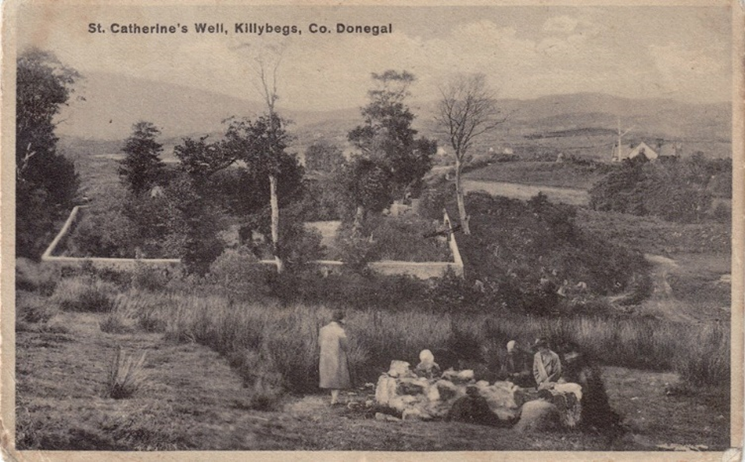
With St Catherine’s Day coming tomorrow, it is a good time to look at an old postcard, and try to pin down its year.
This card belongs to Laura Steinke – she guessed that its date was about 1922 and that it was sent from America by her grandmother soon after she landed there.
How accurate is that date? In trying to find a reliable date, there are several clues. The pilgrims in the photo are wearing clothes in the style of the 1920s or 1930s, possibly in the American style. Could it be that these penitents are visiting the Well in preparation for a voyage across the Atlantic? Or returning after a holiday.
The wall around the graveyard gives a better clue. In the postcard it has been newly built or repaired. That wall has been repaired many times over the years. In 1924 the Glenties District Council proposed to repair the wall. However, the work was not costed and the plan fell into abeyance. In the meantime it must have been in very bad condition, because in 1928 some of the people in Killybegs sent a petition to the Minister of Local Government, pointing out the condition of the wall, and demanding that it be remedied. The Minister referred the matter to the Donegal Board of Health, which sought tenders for repairs. The successful contractors were named as Callaghan and McGuinness. It looks like the Callaghan was Denis, a grandfather of Anne Fallon and the McClafferty brothers, but the McGuinness is unidentified for the present. Denis Callaghan was a professional stone mason who worked on many projects, including the construction of the Basilica at Lough Derg between 1925 and 1929.
It is also known that ‘extensive renovations’ were carried out at the well in 1937, but the 1928 date is more reliable seeing that the owner of the postcard placed it in the 1920s.
(As some of the above is guesswork, please feel free to give your views)
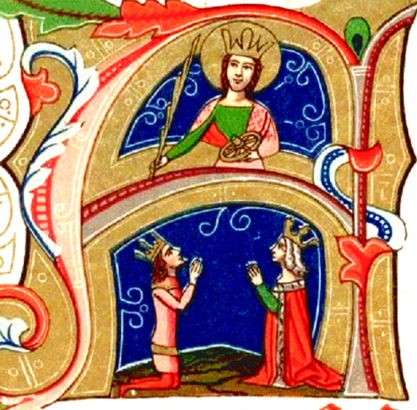
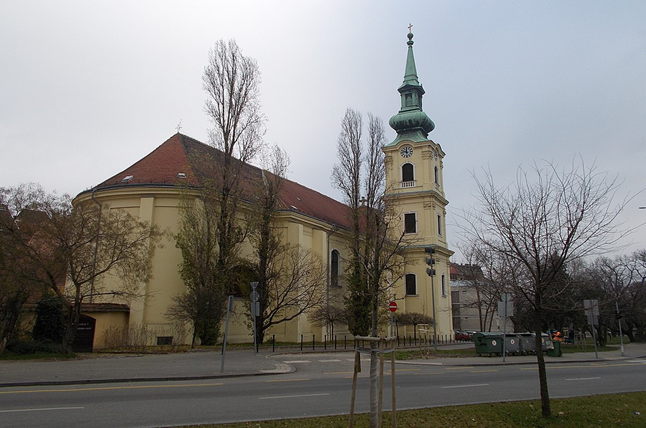
St Catherine of Alexandria was revered in Hungary. This icon of the 14th century shows King Louis and his Queen praying before an image of the Saint. She holds a wheel in her left hand, a symbol of her torture and death.St Catherine’s church, Budapest
THE ELECTRIC TELEGRAPH CAME TO KILLYBEGS 150 YEARS AGO IN NOVEMBER 1871.
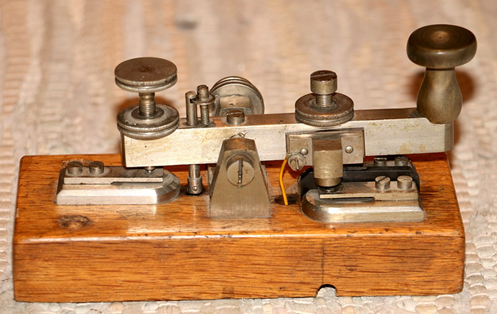
Old-style Morse Sending Key
The Electric Telegraph came to Killybegs in 1871. On Thursday 28th September of that year the S.S.Alma arrived in Killybegs harbour with a cargo of poles for the system. The telegraph had already been installed in Donegal town, and the Killybegs line was next to be erected. They began to put up the poles and wires from Killybegs towards Donegal. By the 24th October the wires had been strung as far as two miles eastwards of Dunkineely. Information on the works is scarce, but it was reported that the Killybegs Telegraph Office would be opened on or about the 1st of November 1871. Carrick, Ardara, and Glenties were next for the telegraph. The Killybegs Post Office at that time was located in Charlie Rogers’s Bay View Hotel, which was on the site of the present one. The Post Office was in existence long before the coming of the telegraph.
Killybegs therefore became directly connected to the outside world for the first time, the telegraph being used by the locals mainly for the transmission of urgent messages, such as a sudden death. Many a heartbeat was skipped when the postboy was seen approaching the front door with the dreaded green telegram envelope in his hand, for who knew what news it contained. The telegraph office also conducted the business intended for Kilcar and westwards.
The commercial business of the telegraph in Killybegs can be divided into two categories: civilian (as in the bad news), and commercial. The commercial side involved the booking of rooms in the local hotels, (especially Rogers’s), and the communication between the fish buyers/curers and their head offices during the herring fishing season. The 1906 herring season generated a large amount of telegraph work for the post office assistants, as the landings were very heavy that year.
Some early examples of the use of the Killybegs Telegraph:
In June 1904 the Lord Lieutenant was travelling to Carrick, and driving his own car heading a convoy of four cars (two cars of servants), he overturned his car in the Glen of Mountcharles. He and his wife were thrown out on the road and were shaken but only slightly injured. Captain Manus Boyle, (a grand uncle of Michael and Joe O’Boyle of Killybegs), who came on the scene and organised the recovery of the car, invited the Lord Lieutenant and his wife to lunch in his hotel. However the meal had been arranged for Killybegs, and was declined. When the party arrived in Killybegs they decided to visit the Industrial School, where the boys were turned out to perform for them. In the meantime, those in Carrick waiting patiently, were advised of the delays by telegraph from Killybegs.
In July 1905 the Archbishop of Philadelphia, Dr Patrick J. Ryan, arrived into the Railway Station on the 8.30 a.m. train, on a visit to his friend, Bishop John B. MacGinley. The Industrial School Band led the Archbishop and the procession to Seabank House on Spout Street. The local reporter sent the news to the Derry Journal via the local telegraph.
Charlie Rogers, the Postmaster, died in 1913, and his daughter Christina was named as Postmistress, assisted by her sister Lizzie. These women were grand-aunts of the late Gwen, Michael and Nuala Rogers. Annie McNamee was in employment as an assistant in 1911. The Post Office was located at the western end of Rogers’s Hotel, in the grocery shop, where the reception desk is found in today’s hotel.
The Titanic
The late Packie Mulreany related: ‘One day in April 1912 Master McConnell (of the Murray School) asked me was my father home (from the Niall Mor School) yet? When he comes tell him that the Titanic has gone down’. That message came into Killybegs by the telegraph.
On the outbreak of World War I, four British gunboats were anchored in the harbour. The fleet Commander received a telegram on the morning of the 4th August, 1914, and the four vessels started their engines in a big cloud of black smoke. This departure was witnessed by the late Tommy Molloy, uncle of Esther Molloy and her sister Mary Goretti. There was heavy telegraphic business to and from the Killybegs office for the duration of the War, as the port was used by the British as a submarine and servicing base.
Following the deaths of Christina Rogers in 1921, the family gave up the Post Office in the following year. Lizzie Rogers died in 1923.
The contract was then taken over by Sarah Crawford, and she located her office where the Sweet News premises are located today. The telegraph apparatus was on the interior wall next Chapel Lane. There are plenty of people still around who remember listening to the buzz buzz buzz of the telegraph sender just out of sight behind the counter.
Sarah Crawford was one of the Conwells who were born in the premises now established as Hegartys’ Centra store. She married Louis A. E. Crawford in 1915 and he was employed as assistant in the Post Office. He also acted as clerk to the Harbour Commissioners. The Crawfords lived on Elmwood Terrace in the house later occupied by the Gillespie family. ‘Mrs Crawford’ as she was known, only took one holiday in her lifetime, to Dublin in October 1950, – her assistant, Madeline McCahill/Crossan, at that time living in the Commons, ran the business when she was absent. She sold her house in 1953 and went to live in Carricknamohil.
During the big autumn herring fishery of 1928 the Post Office was the busiest place in town according to one report. About 250 telegrams were sent every day and perhaps as many received by the herring buyers and skippers of the boats.
In March 1929 four Easkey fishermen took delivery of a new yawl from Killybegs Boatyard. On their voyage to Sligo they got lost at sea and were missing for about twenty hours. Eventually they were found on an island off the Sligo coast, and the news was transmitted by telegraph to searchers at Killybegs.
There was a large number of telegrams received in Killybegs when the new pier was opened by Sean Lemass, Minister for Industry and Commerce, in October 1952
Sarah Crawford continued to serve Killybegs long past retirement age, and died in 1961 at the age of 82. On Mrs Crawford’s retirement the Post Office passed to James Cunningham and his daughters, Mary and Kathleen, on Elmwood Terrace, who gave sterling service until their retirement.
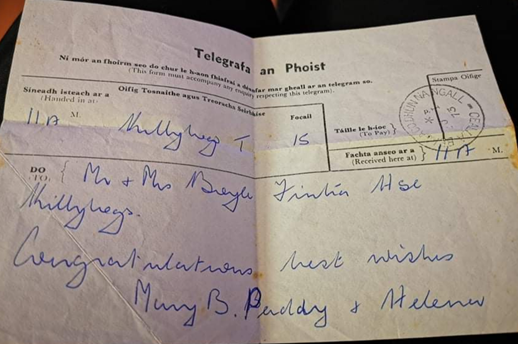
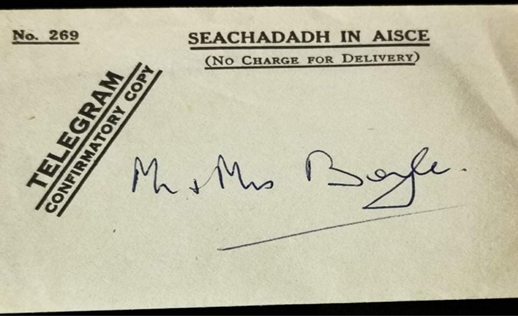
A telegram received in Killybegs in 1975. Not all telegrams brought bad news.Thanks to Rosaleen Boyle for these images.

 killybegsbooks
You must be logged in to post a comment.