The third and final part of the blog on Dodd’s Garden focuses on the one building that can be proven to exist there in the 19th and early 20th century. That was a coffee shop or stand that was put in there in 1897.
Although we are surrounded by mobile coffee shops today, Killybegs had its own permanent coffee stand a hundred and twenty four years ago.
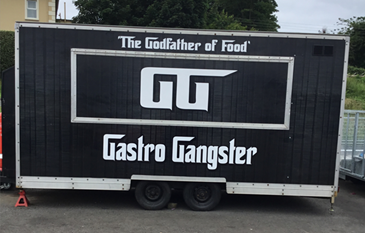
The GG coffee stand in the town car park.
Coffee drinking in these parts is not a new idea – William McGarrigle, who kept a shop on the Diamond, sold Cassell’s coffee there in 1865. During the last years of the 19th century the Congested Districts Board arranged for local women to sell coffee at a penny a cup to fishermen from Teelin to Killybegs in the early 1890s.
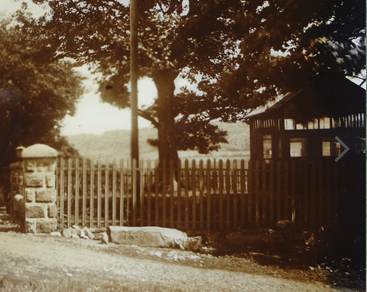
Soon afterwards Killybegs received an actual ‘Coffee Stand’, much along the same lines of those to be seen today, although fixed in position. This was in the summer of 1897 when the new Killybegs stand was erected in Dodd’s Garden. Anyone wishing to know where this Garden was located can refer to the first blog in this series. The stand can be seen clearly in the Lawrence photograph No. 5793.
Lawrence photo No. 5793, the coffee stand sited in Dodd’s garden opposite the Ulster Bank. The stone pillar marks the edge of the main street.
It appears that the idea for the stand was got up by the local Church of Ireland Temperance Club, judging by the majority of the names mentioned at the time. The stand was designed by Young and Makenzie of Belfast, and was built on the site by Andrew Coulter of Mountcharles.
The promoters of the Stand were probably the local Church of Ireland Temperance Society, to judge by most of the names of those who attended its opening.
Built on a concrete platform, the building was constructed of pitch pine. The floor was laid in tiles, and there was a white marble counter. The windows had tinted glass, and the ornamental roof had two revolving ventilators. Patrons could dine inside or sit on seats in the surrounding garden. The manageress was Mrs Robert Morrow.
It is not known when the coffee stand went out of business, but Mrs Mary Anne McGilloway used to talk about it. Mary Anne may have actually visited the stand as a young girl in the 1920s.
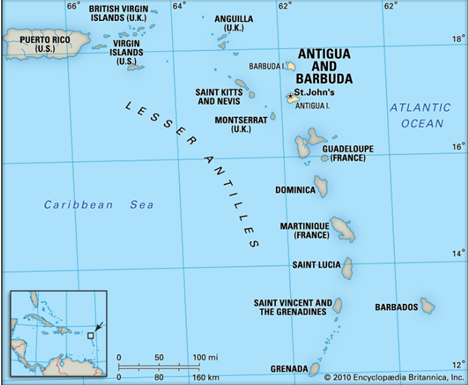
This is part two of my blog on Dodd’s Garden, and features the Island of Montserrat in the Caribbean.
Montserrat is still a British overseas territory situated in the Lesser Antilles chain of islands. Its connection with Killybegs was because of herring exports, a source of cheap protein to feed the servants and slaves on the sugar plantations. Readers of my first Dodd’s Garden blog will have noted the presence of Captain Thomas Atteridge, a resident of Killybegs at the end of the 18th century. He lived with his family in a premises where the Tara Hotel now stands. According to his last will and testament Captain Atteridge had some property in Cork. This would indicate he was one of the Cork merchants who used to re-barrel Scottish and Donegal herring for export to the Caribbean. It is not known how he came to live in Killybegs.
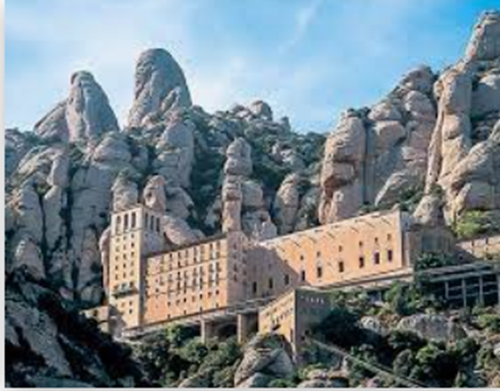
It is claimed that Christopher Columbus when he was sailing in those waters, though that this island looked like the Montserrat area in Spain, and named it after the monastery in that region. For anyone going on a trip to Barcelona the Monastery is well worth a visit, even for the cable-car experience alone. Most people go there to see the Black Madonna, and the fish and chips in the monastery café are a bonus.
The Monastery of Montserrat not far from Barcelona.
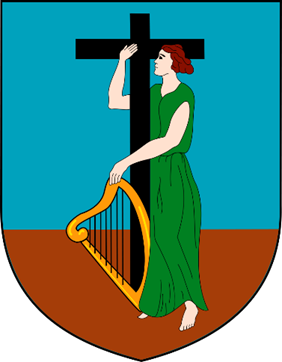
Montserrat is known as ‘the Emerald Isle of the Caribbean’. In the 18th century large numbers of Irish ‘servants’ (probably slaves) were transported there by the British tobacco and sugar plantation owners. Later Oliver Cromwell transported Irish people to those parts. Africans were also brought to the islands, but the Irish were in the majority on Montserrat. In the 17th century the Island became a haven for Irish Catholics who were being persecuted on the other islands in the group.
The British owned Montserrat, as they do today, and they applied the same punitive measures to the Catholic Irish living there as they did during the Penal Laws at home. Except on an island ten miles by seven, their draconian anti-Catholic laws were felt much more severely than they were in Ireland. However the British did not succeed in eliminating the religion of the Irish on Montserrat, any more than they did in Ireland.
The Montserrat Coat of Arms, showing the Goddess Erin with crucifix and harp.
Today Montserrat has many descendants from those first people who were sent there. The island holds a week-long St Patrick’s Day festival where the natives wear ‘Irish tartan’ skirts and Irish national colours.
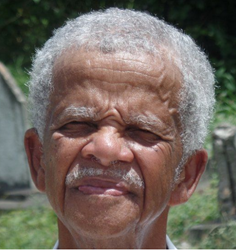
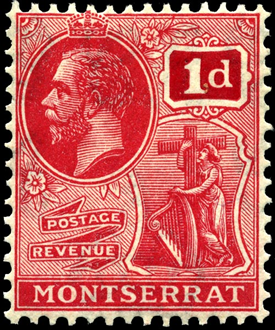
Joe Sweeney, a native of Montserrat, whose ancestors came from Donegal.A 1929 Montserrat postage stamp with Irish iconography
Captain Thomas Atteridge was a Killybegs resident in 1784 when he exported herring to the Caribbean islands. On 2nd October of that year Saunders’s News Letter reported that:
The brig Williams, Captain Atteridge, loaded with herrings, sailed from Killybegs on the first day of June , and after touching the islands of Antigua and Montserrat, where she disposed of her cargo to very great advantage, loaded with rum, and returned to Killybegs in three months and one day.
This was a report from Captain Miller of the British gunboat Langrishe, which had arrived in Sligo following a patrol Donegal Bay in search of smugglers. Captain Miller also reported that:
Not less than 40 sail of sloops and cutters are now on this coast, belonging to the red herring houses of Scotland and the Isle of Man, ten of which lie in Killybegs harbour, partly loaded, and only wanting fair weather to go to Bruckless and Inver to complete their cargoes.
An extract from the Will of Thomas Atteridge of Killybegs.
In the Name of God, Amen.
To my dearly beloved daughter Jane [I bequeath] my dwelling House in Killybegs with furniture & implements of husbandry, except Beds, bedsteads, blankets, sheets and quilts which are to be divided between my dearly beloved sons Philip George and Henry. I bequeath my dearly and best beloved wife Jane Atteridge a hundred and twenty pounds…..
Captain Atteridge’s third son, Henry was baptised in St John’s church, Killybegs, on 29th January 1788. Captain Atteridge’s widow died in Killybegs on 28th September 1834, and was interred in St John’s graveyard, her husband having predeceased her. It is not known what became of the other members of the family.
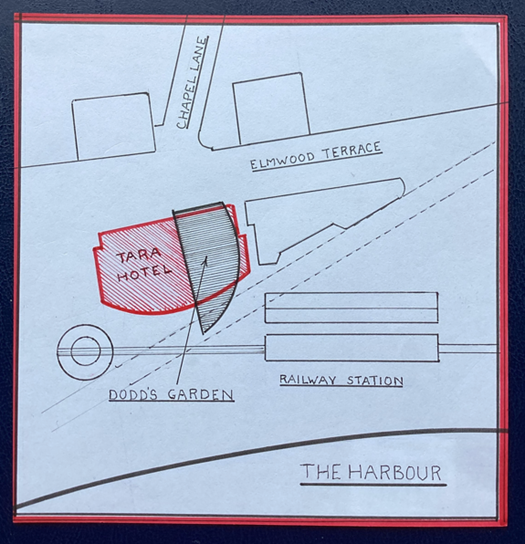
Once there was a place in Killybegs town called Dodd’s Garden, but it disappeared long ago. I asked around and found that Conor McBrearty knew where it was. It was sited under the eastern end of the Tara Hotel, and extended from the today’s Hotel frontage seaward to the shore. The outer or seaward part was known as ‘Dodd’s Rock’.
Composite map showing Dodd’s Garden and the Tara Hotel footprint. (Map not drawn by measurements)
At that time Captain Thomas Atteridge and his family occupied a large premises which ran the whole length of the site where the Tara Hotel now stands. Elizabeth Atteridge, the Captain’s wife, died in September 1834, her husband having predeceased her. She is buried in St John’s graveyard but her husband’s grave has not been found.
In his will, made in 1801, Captain Atteridge left his Main Street premises to his daughter Jane. Jane Atteridge married a British Navy officer, Lieutenant John Dodd, who was stationed in Killybegs, and it is he whose name came to be associated with the Garden. John and Jane had a family of at least two sons, one of which went into business in Ardara, and is buried in St John’s graveyard, Killybegs, and two daughters, Elizabeth and Mary. In due course Mary Dodd married a Liverpool merchant and ship’s captain by the name of William Battersby, while Elizabeth married John McConnell of Rathmullan who became headmaster in the Murray Male School on the Donegal Road.
The Main Street premises and garden now became known as the Battersby property.
KILLYBEGS MARKET HOUSE
By the middle of the 19th century most towns in Donegal had a Market House, where farm produce could be bought and sold indoors. Some of these Market Houses can still be identified, such as in Ardara, (the Courthouse), Glenties (the purple building opposite the museum), Donegal (the Market House Restaurant), and so on. Except that Killybegs had no Market House. This was always a mystery, until recent research revealed the reason.
The Murray Estate owned most of the eastern part of Killybegs town, and in about 1855 they decided to build a Market House. The site they chose was Dodd’s Garden, or the Battersby property. Because it was freehold property, the Estate had to purchase the Garden from the Battersbys. Mary and William Battersby were paid £200 for the site, and preparations for building commenced. William Harte, the County surveyor, was hired to oversee the works, and he placed an advertisement seeking tenders. George V. Wilson was the Murray landlord’s agent in the White House, Killybegs, and Harte would answer to him.
NOTICE TO BUILDERS. TENDERS will be received for the ERECTION of a MARKET-HOUSE at KILLYBEGS, according to Plans and Specifications to be seen at the Office of William Harte, Esq., C.E., Donegal, with whom Tenders, directed to G. V. Wilson, Esq., White House, Killybegs, are to be lodged on or before the 14th day of FEBRUARY [1857]. The Lowest Tender will not necessarily be accepted.
The appointed contractor soon began work, but on inspection by Harte, it was discovered that the foundations for the new House were faulty, not going down to the bedrock. A row ensued, the parties fell out, with the result that the House never got built.
There is a gap of about 36 years in the records during which nothing has turned up in relation to the Garden and site. Late in the 19th century there was a report that Neil McLoone of the Royal Bay View Hotel, who resided where Sweet News is located, had some old buildings demolished because they were obstructing his view of the harbour. It is likely that the buildings he removed were on the Batttersby property.
In 1893 when the Railway came, an entrance was made at the east end of the Garden for access to the Station. This meant that a retaining wall was built on the right hand side of the entrance as travellers approached the Station. It was against this wall that the country people left their bicycles while at Mass on Sundays. Dozens of ‘industrial issue’ black Rudge and Raleigh bicycles were then fair game for the local boy racers as they engaged in some joyriding while the owners worried their beads.
There may have been some developments in the Garden during the 90 or so years up until about 1947, when it was lying derelict. One of these developments was that a coffee stand was built within the site in 1897, but that will be the subject of a separate blog.
One piece of information in respect of the Garden appeared in 1929, at a meeting of the Ratepayers of Killybegs. During a discussion on making the Diamond available for the herring curers during the May fishing
a heated discussion took place regarding the action of individuals being permitted to encroach on Dodd’s Garden for the purpose of building – a plot which had always been recognised as public property common to all.
At that time a Vigilance Committee was in existence in the town, and, apparently this committee had responsibility for finding out who exactly owned the Garden. It appears that the existence of such a committee was a result of someone ‘encroaching’ on the plot. Another committee had been set up to inquire into the delay in transferring the Diamond to Killybegs public ownership. Three members of that committee, County Councillor Brian Brady, Philip Campbell, and Jim Murrin, were also associated with the site in later years. The latter two were both public house owners. Ownership records have not been found for the Garden and site but it must be assumed that those gentlemen listed by the Valuation Office (see below) acquired the premises through fully proper and legal means, possibly from the Murray Estate trustees.
(Brian Brady was first elected to the 7th Dail which sat in Leinster House on 9th March 1932 – 90 years ago today. He was the second Killybegs-born TD to sit in Dail Eireann)
The Cinema
In the 1940s Dodd’s Garden was, according to the Valuation Office, in the ownership of four people: Johnny Cunningham (John Cunningham & Co grocery store); Charlie Murrin (an uncle of the late Joey), Brian Brady, T.D., and Jim Murrin, publican, and father of the late Brendan.
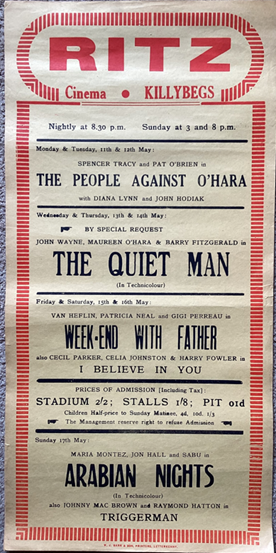
Killybegs folklore had it that these men had planned to erect a cinema on the site, but due to the shortage of materials during the War, the project did not proceed. In the meantime, Joe McBrearty, father of Claire Tully and Conor McBrearty, fitted out a cinema in a building on his property fronting on to Chapel Lane, and the Ritz Cinema came into existence.
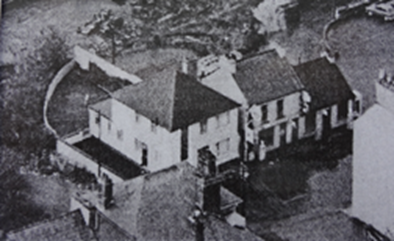
Ritz Cinema poster from 1953 It appears that Dodd’s Garden, at some time, passed to Jim Murrin, and from Jim to his son Brendan who built a house on it.BrendanMurrin’s house (left) on the site of the Garden, withthe old Pier Bar on the right.
As to the part of the site to the westward, where the Pier Bar stood, the first person to run a public house there was Philip Campbell, (already mentioned) a native of Glen. Philip ran a pub on Back Street since 1913, and he was granted a temporary spirit licence in 1939 to have a pub on the part of the site to the west of Dodd’s Garden. His reason was that there was to be an AOH Demonstration in town on the 15th August of that year, and Philip knew he would do better business on the Diamond than on Back Street. The Justice, while granting the licence, ruled that the Back Street premises should be closed, and that the new pub’s opening hours must be from four o’clock until seven. Philip died in 1950, and the Diamond pub was continued by his son, Michael Hugh. It was occupied thereafter by a succession of publicans – how many people can name them, down to Johnny Paul McGuinness? In recent years the McGuinness family demolished all the buildings on the site, and built today’s Tara Hotel, arguably the finest building erected in Killybegs, and a great asset to the town.
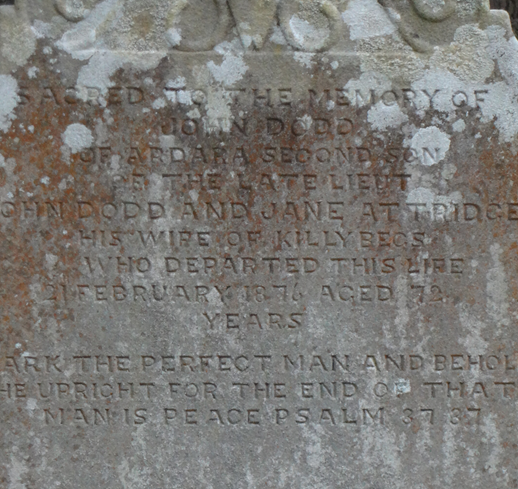
The headstone over John Dodd of Ardara, in St John’s churchyard, Killybegs. Sacred to the memory of John Dodd, of Ardara, second son of the late Lieut John Dodd and Jane Atteridge his wife of Killybegs, who departed this life 21st February 1876, aged 72 years
 killybegsbooks
You must be logged in to post a comment.