
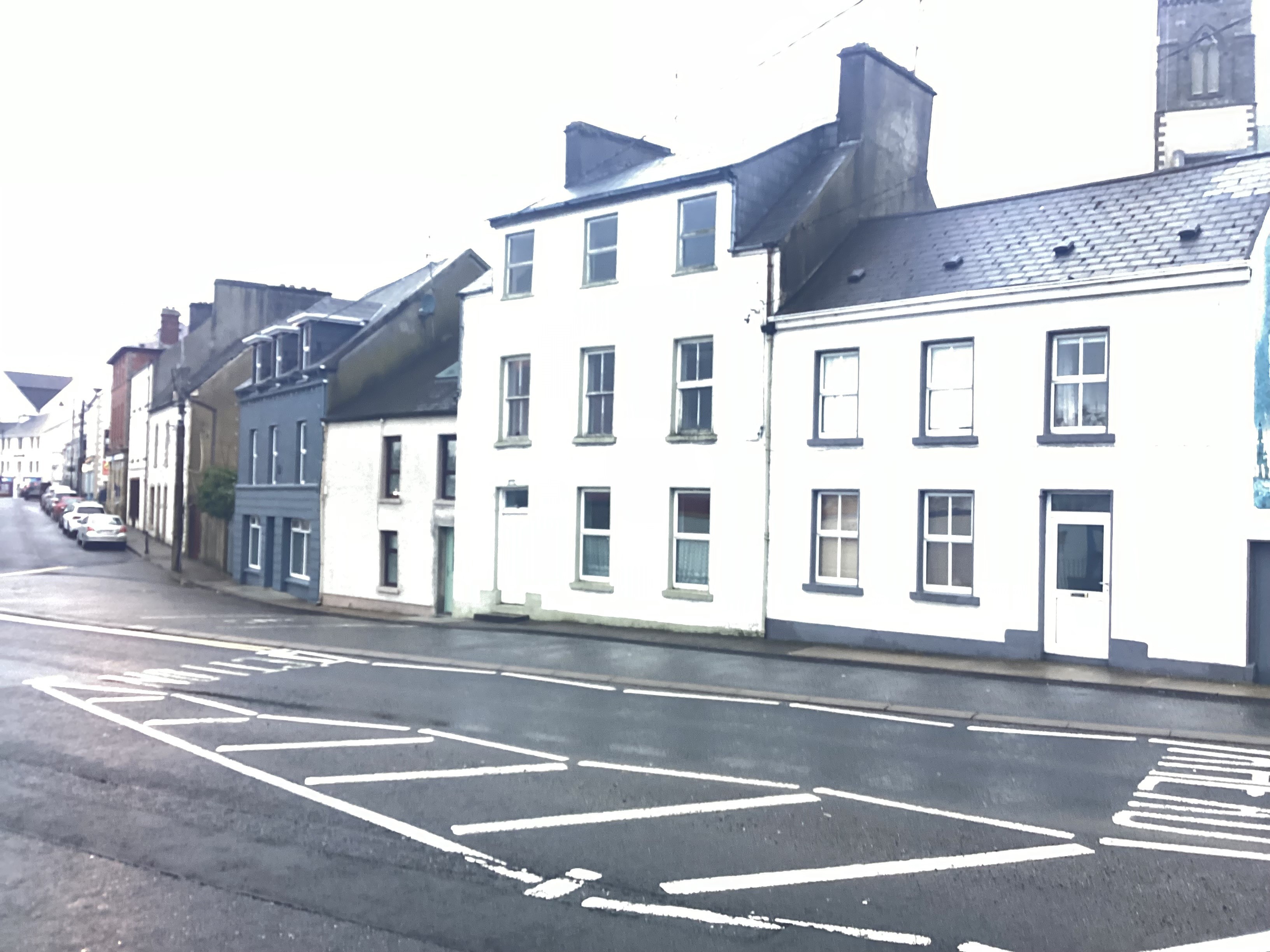
Elmwood Terrace looking from east to west.
This blog will outline the history of Elmwood Terrace in several parts, starting from the east end next Mulreanys’ Brae.
The street that became Elmwood Terrace was created when the town of Killybegs was built at the beginning of the 17th century. The town extended from the Bridge River in the west to Mulreanys’ Brae on the east side. The Terrace took up the space from the Chapel Lane to Mulreanys’ Brae, which it still does. The Terrace took its name from the row of elm trees which stood in a green patch on the south side of the street. This patch was known locally as The Shrubbery, which is now occupied by the Tara Hotel outdoor area. At present the history of the Terrace can be reliably traced only to about 1800 due to lack of records.
It is proposed in this blog to deal with the Terrace house by house, that is with each building or site.
I have identified the houses by number from the east to west as Nos. 1 to 7 next Chapel Lane.
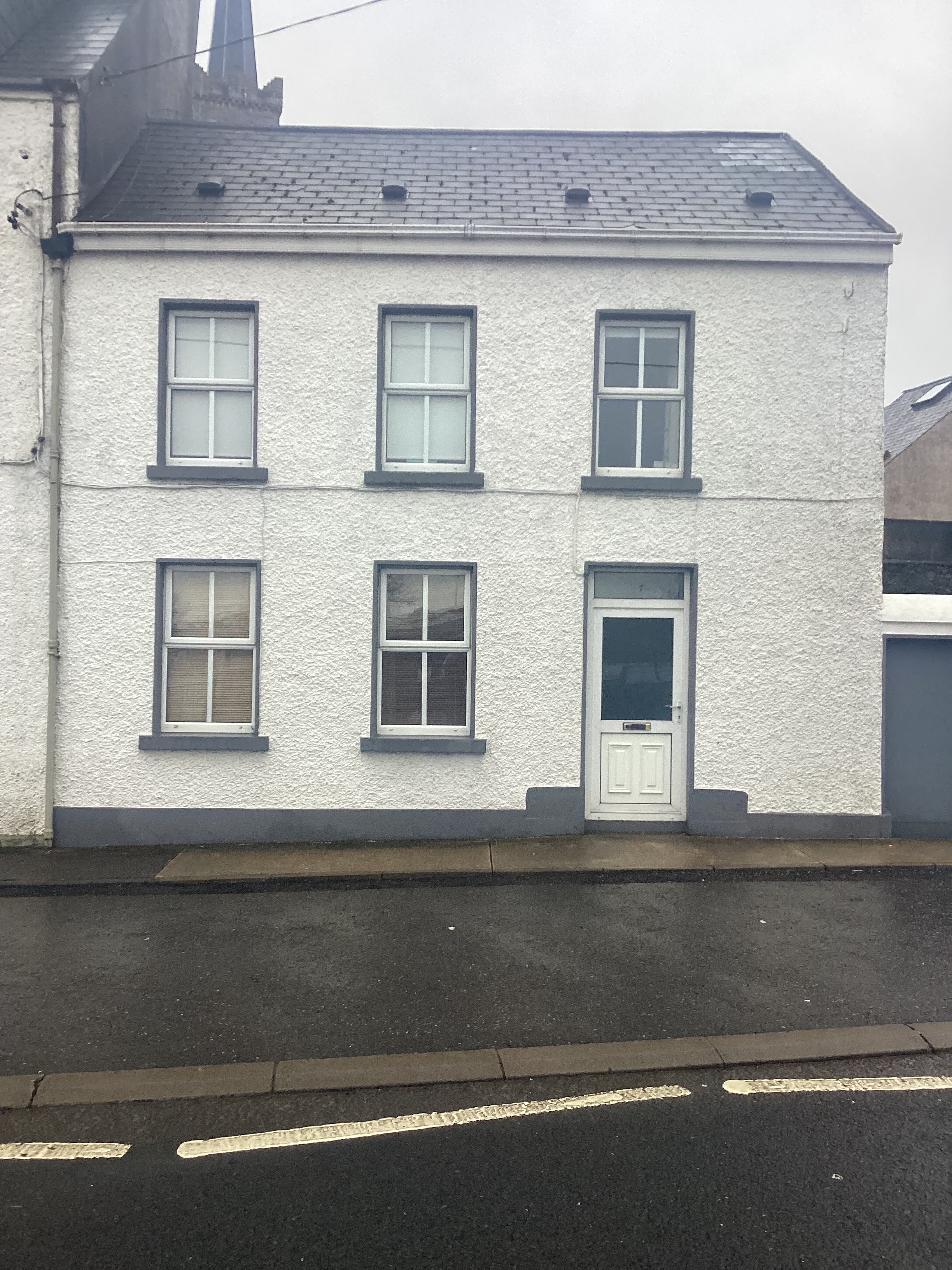
House No. 1
The first house – that of Una Cunningham – with the Armada mural on the gable – gives the appearance of having been built not so very long ago. This may be true because early 19th century maps show a row of small houses fronting the street. Griffith’s Valuation of Killybegs, 1857, shows a similar row of houses, with a vacant site at the corner of Mulreanys’ Brae, much as it is today. It is likely that House No. 1 in its present form was rebuilt on the site of an earlier, smaller house. There is documentary evidence that Connell O’Byrne was in possession of this site and its house(s) since 1856. O’Byrne was also closely associated with House No. 2, but that will be dealt with later.
Although O’Byrne was the first occupant of House No. 1, reliable information about its later inhabitants does not emerge until the end of the 19th century.
Occupying the house then was Charlie Rogers of the Bay View Hotel. Charlie married a native of Co. Clare and Killybegs teacher, Jane Coghlan in 1895. Jane had been teaching in the Commons School since 1883, and gave up her job to enjoy married life. It is thought that they moved into House No. 1 on their marriage. At that time Charlie’s father, old Charlie Rogers, was running the Bayview Hotel on Main Street. This Hotel incorporated a grocery, pub, etc. For whatever reason, young Charlie, Jane, and their children, John Joe, Charles V., and Francis, moved to Strabane in 1900 where they managed a public house and grocery. Two more children, Thomas and Michael, were born to them while in Strabane.
In their absence house No. 1 was let to Henry McAllister, who was chief engineer on the Congested Districts Board steamer Granuaile. This ship can be seen in this Lawrence photograph, alongside the pier.
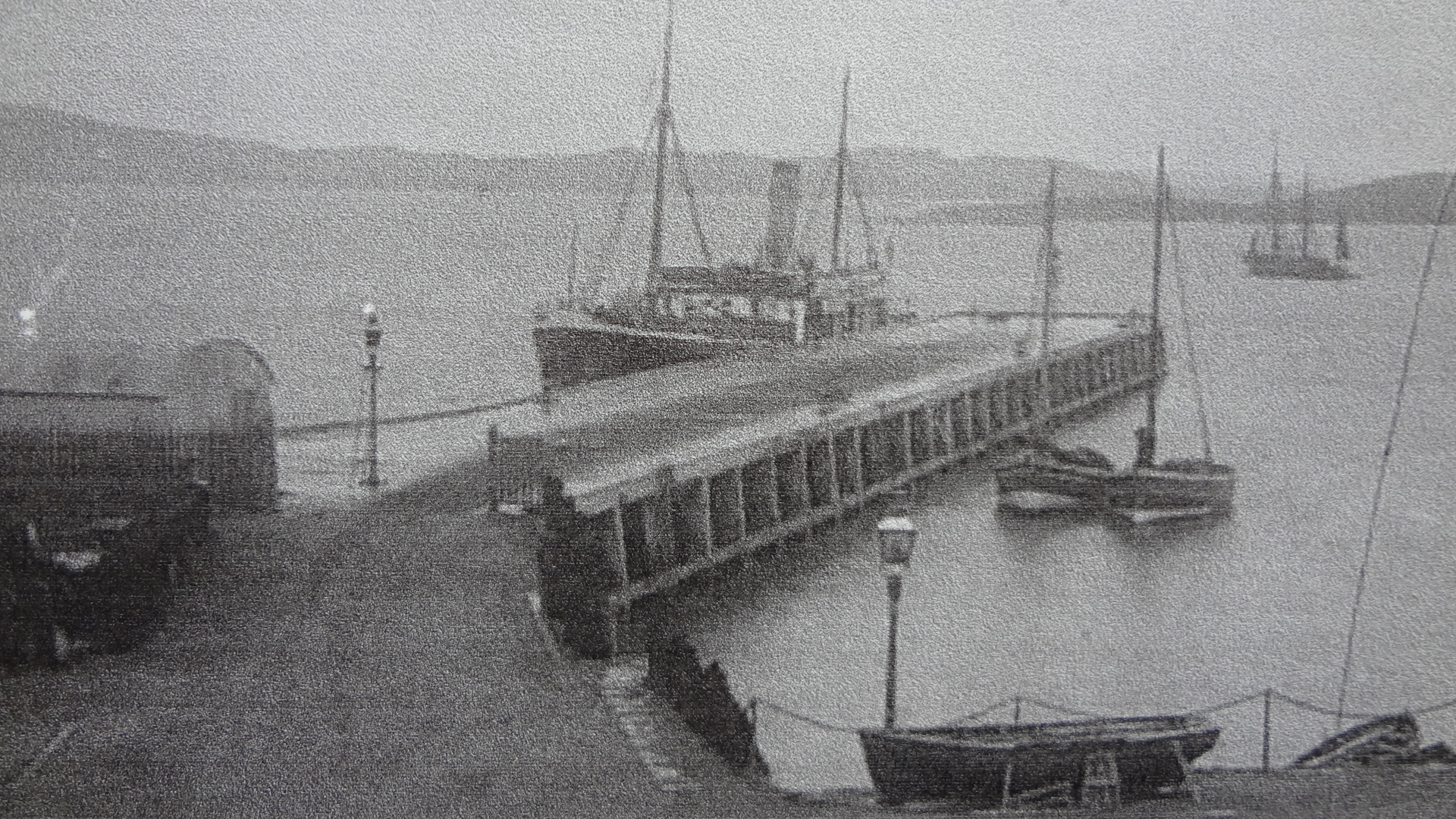
Henry McAllister died in the Elmwood house in January 1901, after contracting pneumonia, leaving his wife, Elizabeth and two young children. Charlie Rogers’s mother who had been running the Bay View Hotel, died in 1906, and Charlie returned from Strabane to take over the business and to live in House No. 1. In 1913 his father, who had been ailing for some years, died in the Connaught Hotel, London, where he had gone for health reasons. ‘Young’ Charlie, being the eldest son of the Rogers family remaining in Killybegs, inherited the hotel, grocery, public house, and coal yard. This coal yard was located behind the present Diamond Centre next Mellys’ café, and gave its name to the adjacent Coalyard Lane. Charlie built up the business, making improvements to the hotel, and was seen as a leading businessman of the town. This success continued through the First World War as the firm was well placed to supply the British Atlantic fleet with coal, food, and other stores when Killybegs was a naval base. The extent of the business can be gauged by the fact that the submarine support ships, HMAS Platypus, and HMS Vulcan, anchored in the harbour. The Platypus alone had a crew of up to 800 men.
‘Young’ Charlie suffered a heart attack in 1929, but made ‘a wonderful recovery’. However he died of the same cause a year later, aged 62, and the hotel passed into the hands of his wife Jane. At the time it was said of Charlie that-
He was one of the most successful businessmen in Killybegs. By his energy, business acumen and personal integrity he succeeded in maintaining and extending the establishment which is associated with the Rogers family for [many years].
In 1915 his brother Michael had married Josephine Leeson who ran a drapery shop in town, and they took over the Elmwood house on Charlie’s death. A Killybegs local once said of Michael: he was a big man, and when telling you something he would have your side sore with elbowing you.
Michael and Josephine had four of a family, one of whom, Mary, married Dr Michael O’Boyle and became the mother of Terri Tully and the late Grainne Bach. Michael Rogers died in 1954, and some time afterwards his widow, Josephine, moved into a smaller house on St Catherine’s Road, purchased for her by her son-in-law, Dr Michael O’Boyle. This house was built as a retirement home by Maggie O’Donnell, the first Lady superintendent of Killybegs Industrial School. She chose the exact spot for the house by throwing an Agnus Dei into the field. Maggie died in 1950, and her house was purchased by Dr O’Boyle. The house, a bungalow, known as Grianan Muire, still stands, looking out on the harbour on the town side of Seamus Tully’s offices. Josephine Rogers put her Elmwood house up for sale by public auction in December 1961. The household furniture and effects were offered for sale at the same time:
bedroom, sitting room, kitchen and hall furniture of excellent quality, as well as china, delph, clocks, mirrors, ornaments, kitchen-ware, etc.
The premises were purchased by Johnny Cunningham, St Catherine’s Road, and there is no doubt that some of these items of excellent quality can still be found in local houses.
[Additions or corrections to the above are welcome. Next up is House No. 2 which will appear soon]
 killybegsbooks
You must be logged in to post a comment.