House No. 3
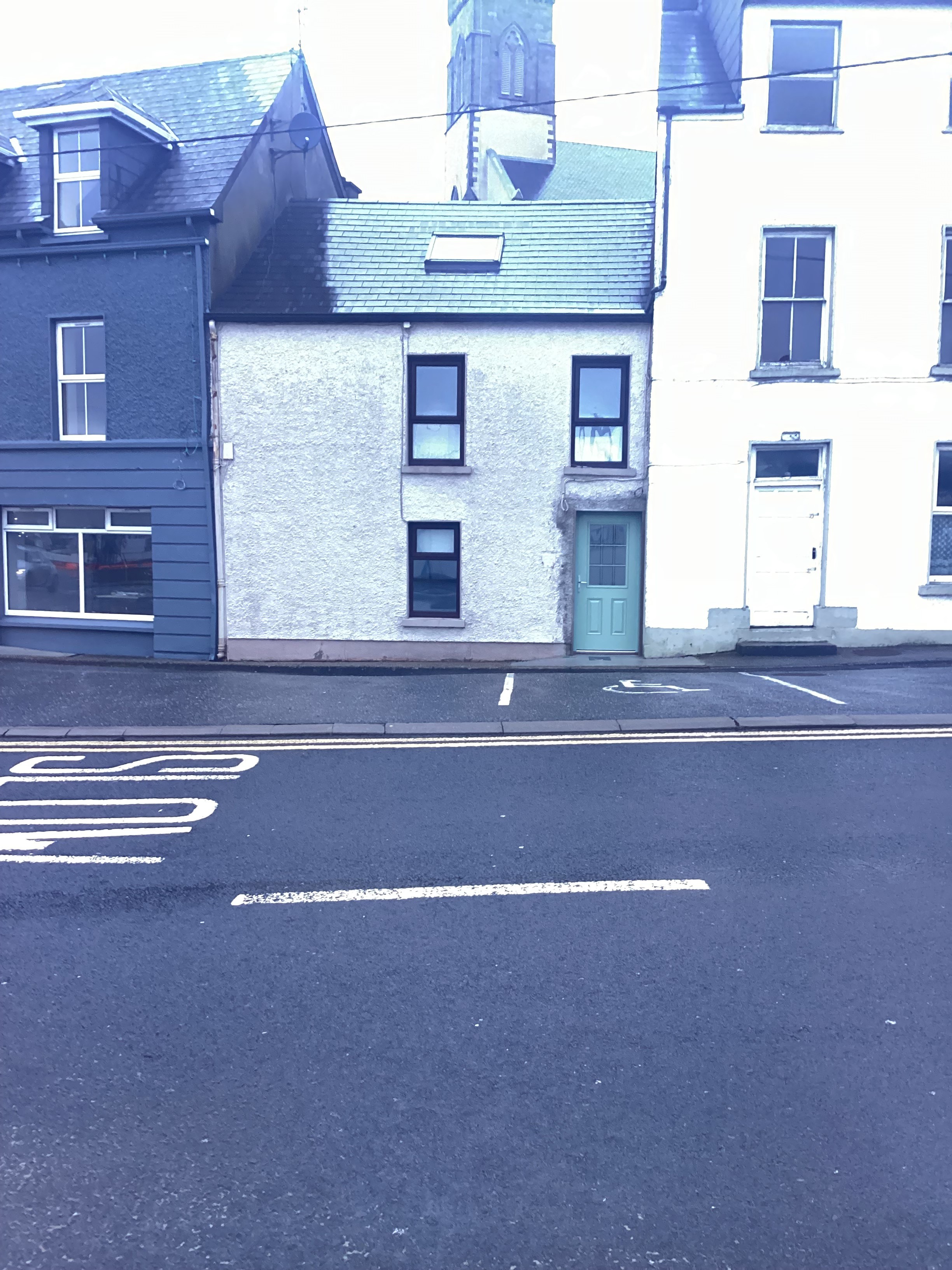
This house is still visible today as it was in the 19th century. The east side of it looks like it has been cut off, but it is, in fact the frontage of a full house, or part of the frontage. Two old, smaller houses were demolished on its east side, and the new house No. 2 was built up against it.
In 1857 house No. 3 was in the possession of Robert Rodgers of Keelogs, Inver, who had other properties on Elmwood Terrace. The next record appears in the Census of 1901, in which the house is occupied by Mary McCloskey (60), and her son Anthony Conwell, (40). Anthony worked in one of the several bakeries in town. His mother died in 1908, and Anthony was still alive in 1911. From 1915 house No. 3 seems to have been owned and occupied by a newly married couple, Sarah and Louis Crawford.
Sarah Crawford, the Postmistress
Sarah was the daughter of Anthony and Anne Conwell who lived and ran a grocery store where the Hegartys’ Centra store is now located on Main Street. Sarah married a Donegal town man, Louis A. Crawford, in 1915, he being 35, and her almost 40. They had no family, so they took up different careers, Sarah taking over as Postmistress. The Killybegs Post Office was then located in the west end of the Bay View Hotel, where it was operated by Christine and Lizzie Rogers. (Sisters of Charlie who lived in house No. 1) When Christine died in 1921 the Post Office went out of the Rogers family, and Sarah Crawford was appointed Postmistress. She opened her new Office in the premises on the corner of Main Street and Chapel Lane, where Sweet News is now located. Her husband, Louis, acted as an unpaid assistant. Louis had been Clerk of Killybegs Petty Sessions (Court) under the British system from 1912 to 1922. Afterwards he held the position of secretary to the Harbour Commissioners from 1930 until 1942. He was also Commissioner for Oaths, Electoral registration officer, Auctioneer, and certifier for American pensions. This last was a scheme whereby the U.S. Government awarded Irish-American soldiers a gratuity of 50 dollars. Crawford’s task was to verify each application. One of Louis’s assignments as auctioneer was to advertise Corran Lodge for letting at the end of 1936. Superintendent Thomas Martin and family arrived soon afterwards and leased the house as a temporary residence.
Louis took ill in 1942, and died two years later. Sarah retired as Postmistress in 1953, and put her house No. 3 up for sale. It appears that there were no buyers, as she was obliged to accept a rental tenant. This was John Joe Gillespie, who moved in there possibly after the death of Louis Crawford in 1944. At least, John Joe was gone from the old Gillespie home in Cunlin by 1937.
He operated a taxi service for many years, and was frequently hired by the Industrial School to transport boys to various places. Bruckless folklore states that a group of boys broke out of the Industrial School in the 1930s, and were ‘recaptured’ in the countryside above Dunkineely. This would seem to be true, as John Joe was paid £1 5 0 in September 1934 for 2 cars (journeys) ‘after absconders’.
Photography
John Joe also took over as the ‘official’ photographer in Killybegs in 1933, following the death four years earlier of Hugh Kelly, the previous holder of that ‘post’. Hugh was just 24 when he died. He was the eldest son of Mick Kelly, later Station Master in Killybegs, and was described as one of the most lovable, genial and courageous souls that Killybegs had ever known. The Kellys lived in the house on Upper Main Street between the Bank of Ireland and the Milis shop. John Joe Gillespie’s sister, Rose Ann, had married a sailor who was based in Killybegs during the First War, by the name of Charlie Cox. Charlie was a member of the crew of HMAS Platypus which was based in the harbour during the First World War. He later became an official Navy photographer based at Rosyth, and he and Rose came to Killybegs each year on holidays. Rose died in Rosyth in 1939, and it is said that Mr Cox married again later. It is likely that Charlie Cox’s profession had something to do with John Joe taking up photography. He concerned himself mostly with the provision of passport photos and local religious events, and some of his glass negatives have survived. It would be good to see them sorted and catalogued, as they would be a precious resource for the social history of the area.
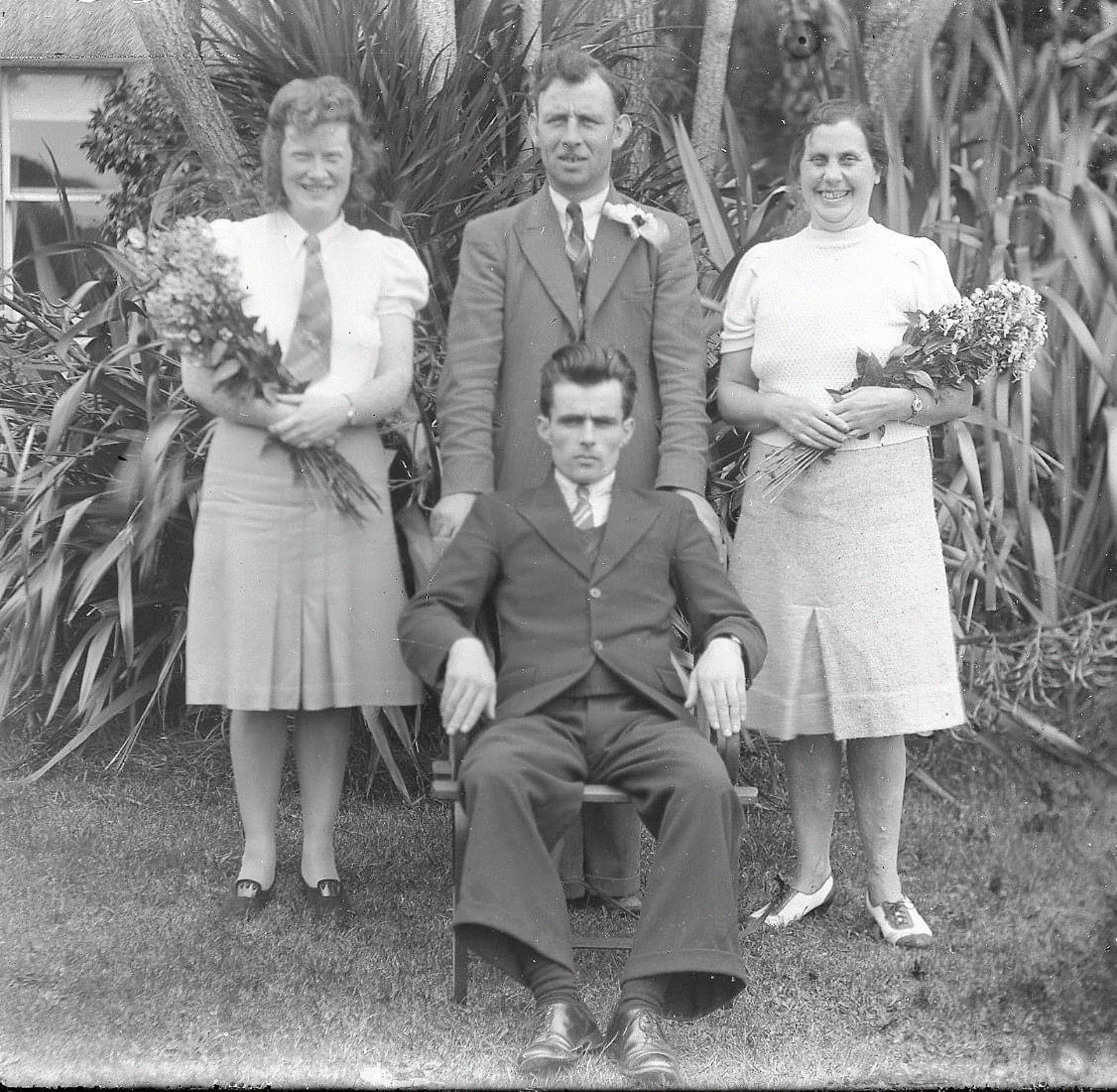
I don’t know who owns this photo, so I cannot credit anyone with for it, so apologies to its owner for using it.
It was almost certainly taken by John Joe Gillespie, as it is set in the garden of the White House, and his sister, Margaret (Dolly), on the right. It seems to be a wedding photo, and Hugh Callaghan, sitting in front, can be identified as the best man. The question is: Who got married? Dolly Gillespie married John P. McShane, so is that him standing? John spent a long time in the U.S., and Margaret’s shoes are kind of American looking. On the other hand, her sister, Rose, married Charlie Cox; would that be Rose on the left, with Charlie beside her? You can reply to this query through killybegsbooks.com
In the Spring of 1961 John Joe and his wife Bridget Gillespie entered into an agreement with Catherine McHugh next door whereby they would live in with her and take care of her in her old age. However, Catherine died in July of that year. (See ‘House No. 2’ in this series)
During her retirement Sarah Crawford was living in ‘Cottage No. 77’ in Carricknamohil, and she again tried to sell the town house in 1961. However she died soon afterwards, with the occupancy of the Elmwood Terrace house unchanged. It is still in the ownership of the Gillespie/Beirne family.
Thanks to Maureen O’Neill and Laura BeirneGormley helped with this blog.
 killybegsbooks