House No. 4
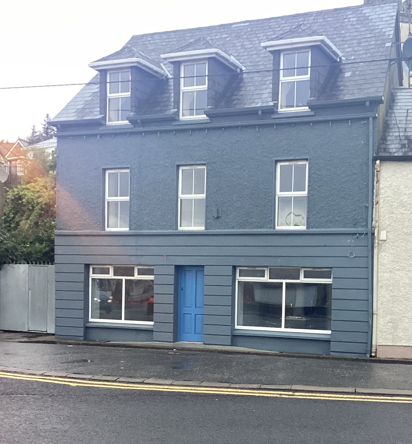
House No. 4, soon to be home to the Credit Union.
This blog should have started with House No. 2 because of a woman who was known long ago in Killybegs as ‘Mrs Henry’. Some people thought she was associated with house No. 2, and also with house No. 5, but no one could confirm this. Also someone reported seeing an elderly lady standing in the doorway of house No. 2 in the late 1950s, and thought it was Mrs Henry. (The person in the doorway was Mrs Catherine McHugh). Some of Mrs Henry’s descendants knew she owned one house on Elmwood, but not two. The answer to part of this puzzle will become clear below. The other part will be clarified under House No. 5 later.
Emma Kilby Henry. Before introducing Emma K. Henry it is necessary to go back to the closing years of the 19th century. As the 20th century dawned a new era seemed to open up for Elmwood Terrace. The Ulster Banking Company of Belfast played a major role in the layout of the Terrace at that time. The Killybegs branch of the Ulster Bank was then located in what is now the Sweet News premises. Across Chapel Lane, and on the corner, stood Michael McGill’s grocery and hardware shop, an old and very large establishment. This premises and the McGill family will be treated under House No. 7 to be posted later. In the 1890s the Ulster Bank acquired McGill’s premises and also House No. 4 and its garden. They erected their new red brick bank on the first site, and sold the other one to Henry Judge. This other site included the (still) vacant yard between House No. 4 and House No. 5.
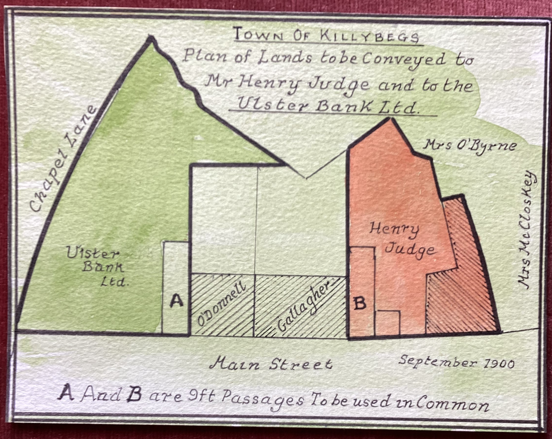
A reproduction of a plan of 1900 showing the sites sold by the Ulster Bank.
The ‘Gallagher’ house refers to House No. 5, and the ‘O’Donnell’ house
refers to House No. 6 in this blog. These houses will be dealt with in later blogs.
Who Was Henry Judge? Henry Judge was born in Donegal town in about 1844, and worked in the offices of solicitor James Dunlevy as a clerk. He first appeared in Killybegs in 1894 as a Commissioner for Oaths but his day job is not known. Soon he was appointed Clerk of Killybegs Petty Sessions (Court). He married Margaret McClintock in the Methodist Church in Donegal town in 1882. By 1897 Henry and Margaret were living on Main Street, Killybegs in the house immediately to the east of the present Boathouse restaurant.
The census of 1901 shows the Judges living there, and their 14 years-old niece, Emma Kilby McClintock, Margaret’s niece, in residence with them. In 1910 Emma married James Oliver Henry of Ballyederlan, St John’s Point, and set up house there. In the following year their first child, Henrietta, was born. James Oliver was a local magistrate who sat on the Bench at Killybegs Petty Sessions. He was involved in an unusual case concerning a pound note in 1912. (See this story at the end). The late Naul Henry of Dunkineely was a son of James Oliver and Emma. Naul married Elizabeth Boyd of Loughros Point in 1950. They are not part of this story.
Henry and Margaret Judge lived in house No. 4 until his death in 1912. Margaret died there on 17th January 1924 at age 76, and was interred in St John’s graveyard, Killybegs. Henry is buried in the Abbey cemetery, Donegal town, this separation being the result of ‘a family dispute’ it is said.
He left the house to the niece, Emma, and she moved to House No. 4 following the death of her husband in 1945. The occupancy of the house between Margaret Judge’s death in 1924 and 1945 is not known at this time.
(Henry Judge had also purchased house No. 5 further along the Terrace years earlier – this house will be dealt with next time).
Henry had also bought the Robertson Schoolhouse on St Catherine’s Road, and bequeathed it to the Methodist Church. This is how it became known as the Methodist Meeting House. It has been in the ownership of the John Conaghan family of the Brocky, Killybegs, for many years.
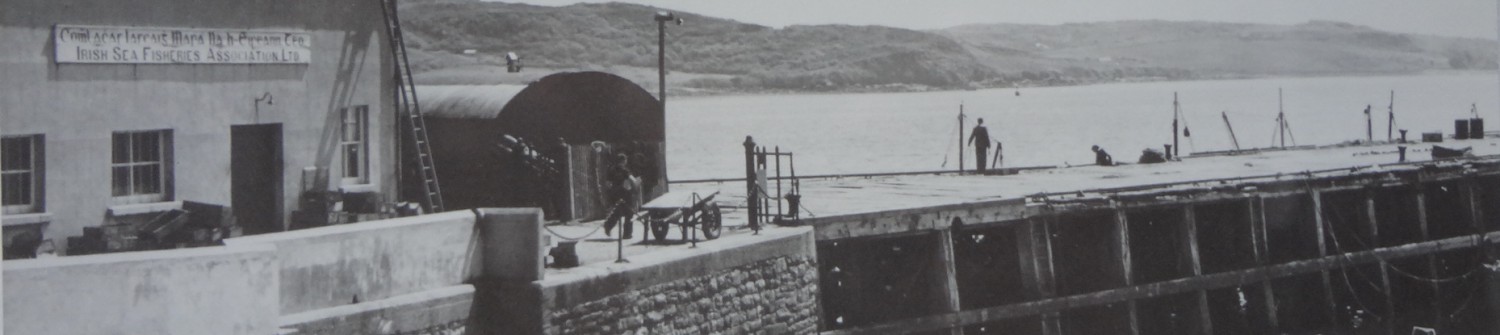
Electric Light. Before the Electricity Supply Board came along the town electricity was provided by the Electricity Station at the local Boatyard. The Boatyard and generating plant were owned by the Irish Sea Fisheries Association (ISFA). Emma Henry had her house No. 4 wired for electricity in 1950. Local contractors were hired to wire the houses for the new AC current of the ESB. The ESB did not have a high opinion of the people of Killybegs and Kilcar. They posted notices advising householders that: Houses that are not wired cannot be supplied with electricity (!).
During the change-over the ISFA issued the quarterly electricity bills, and its officer went around each house collecting the money and issuing receipts. Emma was careful to preserve her receipts, and several of these have survived. The receipt below shows the local ISFA officer, Sean McGettrick, as the collector in 1950, and the cost of wiring the Henry house. Miceal Quinn, starting out in his career, had contracts for wiring houses for the new electricity at that time, and it is most likely that he wired Mrs Henry’s and the other Elmwood houses. Willie McShane of Kilcar was another contractor undertaking this work.
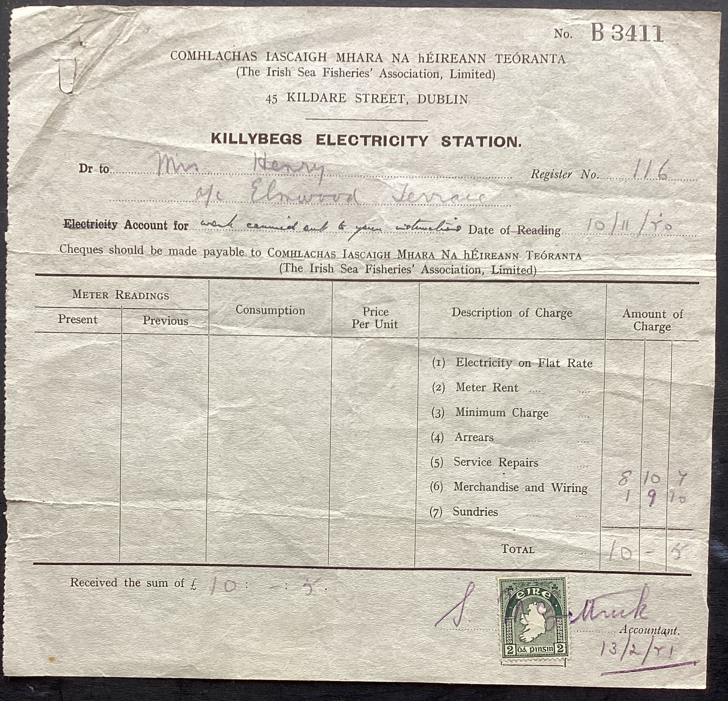
A receipt for £10 0s 5d for work carried out to your instructions from the ISFA, KILLYBEGS ELECTRICTY STATION, to Emma Henry, dated November 1950.
Emma Henry died on Elmwood in November 1970, and was interred in Killaghtee cemetery following a funeral Service in her home. The house was inherited by her daughter Henrietta Emma Olivia Green.
The Elm Cafe. Soon afterwards Jackie and Philomena McBrearty purchased the house and turned it into a commercial premises by opening the Elm Café. It was they who changed the appearance of the facade by putting in the two large picture windows in front. In 1977 it was purchased by Andersons Mink Farms Ltd.
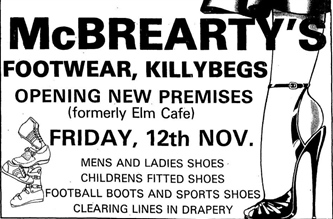
McBrearty’s Footwear. The premises was sold in 1981 to Conor McBrearty who began trading as McBrearty’s Footwear in November 1982.
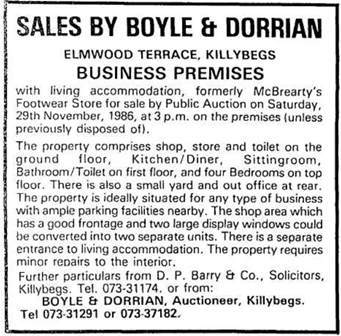
The premises were offered for sale in 1986:
The Case of the Pound Note. Emma’s husband, James Oliver Henry, was a local Magistrate, and he sat on the bench as a Magistrate at Killybegs Petty Sessions Court. This was before Independence. On Monday 13th May 1912 he was involved in the case of a young man by the name of Erskine, who found a pound note on the street while going in the direction of Killybegs pier. He was charged with larceny by RIC District Inspector Augustus Le Clere MacDonald who resided in the Ardara RIC barracks. The famous solicitor, James Dunlevy of Donegal town defended the case. He said the law was well settled, for the finder of an article had good title to it against all the world except the owner thereof, and no charge of larceny could arise or be sustained unless it was found that he had appropriated it to his own use. A pound note was simply a promissory note payable to bearer on demand, and that no owner had turned up to claim the lost pound. The man could not be charged with the offence so long as he was prepared to give the owner a pound. There was no intention of appropriating the money in that case as the man was not hiding it or attempting to hide it. Everything was above board and publicly given to the finding. In point of law, the police or no one else were entitled to the custody of the pound, and his client was entitled to hold it until the true owner turned up, and the Court should therefore, order the return of the money now in the custody of the constabulary to the man charged. The magistrates ordered that the money be returned to Erskine.
At the time of writing Ballyshannon and Killybegs Credit Union is about to move into these premises from their location on Main Street.
 killybegsbooks
You must be logged in to post a comment.