
HOUSE NO. 7. THE ULSTER BANK.
The Ulster Bank has occupied the site on the corner of Elmwood Terrace and Chapel Lane for just over 120 years until it changed hands in February 2023.
The piece of ground was occupied by several tenants down through the years, but reliable information is available only from the beginning of the 19th century. Followers of this blog will remember two out-of-town names from my piece on Dodd’s Garden – Atteridge and Battesby – they lived where the Tara Hotel now stands.
To return to Elmwood Terrace – another such name now comes into play – William Henry Babington, who ran a business in a premises on the corner where the Ulster Bank was later built.
In 1814 Babington was established in Killybegs as a fish merchant. Before settling in the town he had operated mainly on the north coast of Donegal from late in the 18th century (1789). In his early years he had been a soldier, but eventually returned to the fish business, owning his own vessel which engaged in the herring fishery at Killybegs. There will be more about Babington in a different blog.
The First Rogers
The first of the Rogers Hotel family to come to Killybegs was Frank. When Babington moved on, Frank took over the premises, and traded there for a few years. He then moved to the Diamond and became the proprietor of an establishment which he called The Bay View Hotel. He sold the former Babington premises to Cornelius McGill for £92 in 1842 in order to concentrate on his hotel, which included a public house and grocery.
Cornelius McGill carried on a grocery and hardware store but he died in 1847, and his wife Mary died ten years later. They are both buried in ‘St Catherine’s’ graveyard just inside the entrance gate. Their son, Michael took over the business – he was about 24 when his father died – and continued the grocery. In 1865 Michael married Mary, a daughter of Paddy Ramsay, a Killybegs tailor. Mary and Michael had thirteen of a family which included three sets of twins. The names of the children are given at the end.
Michael’s expertise in running the grocery shop is not known, but in 1888 when he was about 56, he received a loan from the Ulster Bank, amounting to £290 11s 4d. The bank was then located in what is now the Sweet News premises. There is evidence that Michael was paying off the loan in the normal manner. The McGill and Rogers families were on friendly terms, resulting from their business dealings. Michael was in the habit of visiting Rogers’s hotel in the evenings, leaving in the early hours. Sometime after midnight on the morning of the 2nd February 1892 his body was found floating in the tide opposite the hotel. One of his legs was broken and his neck injured. He had fallen into what was later called the ‘dock’ between the old stone pier and the small boat slipway. Both the pier and the slipway are now covered by the Shore Road. There were no lights near the pier at that time, and there was no wall or fence to stop people falling into the tide on a dark night.
Although a significant businessman in the town, not much is known about Michael. It is known that he removed his children from the Murray Schools on the Donegal Road, and sent them to other schools. The parish priest of Killybegs, Monsignor James Stephens, had opened his new Niall Mor School in 1879 in opposition to the Murray Schools. The Murray and the Niall Mor were essentially denominational schools. The McGills had five children of school-going age at that time, and they most probably were attending the Murray Schools. Monsignor Stephens needed to fill his new school, and exhorted parents to withdraw their children from the Murray Schools. Michael McGill withdrew his sons Charles (10) and Joseph (9) but sent them to the Commons School. Presumably he sent the others, Catherine (7) and Patrick (5), to the Niall Mor.
Michael served on the local relief committee during the famine of 1880, when their meetings were held in Rogers’s Hotel. He continued his long-term friendship with the Rogers family, and was appointed treasurer in 1881 of a committee which presented a purse of sovereigns to a Rogers son. This was Patrick E. Rogers, grandson of Frank, who was emigrating to the far west, i.e. America.
The McGill girls in the social and cultural activities of the time in Killybegs, mainly by performing in concerts. Before the Foresters’ Hall was built the Niall Mor School served as the main venue for community events. It is recorded, for instance that Ellen and Annie McGill took part in concert and performed in a sketch entitled More Blunders than One. The concert was organised in 1894 by Master Patrick Mulreany, headmaster of the Niall Mor to raise funds to repair the storm-damaged roof. Ellen and Annie were only two of a big number of young women who lived within yards of each other in that part of town, and were the mainstay of the local concert scene. The Rogers family of the hotel had Lizzie (30), Christina (23), and Mary (21). The Conwells (Hegartys’ Spar store) had Ellie (30), Kate (25), Lizzie (22), Maggie (20), and Rose (16). The McGills had Mary (33), Catherine (29), Ellen (24), Annie (24), Teresa (21), and Christina (20). The O’Donnells (Mary and Kathleen Cunningham) had Maggie J. (23) and Susan (31).
Ulster Bank takes action.
Despite two of Michael McGill’s sons being in their early twenties when their father died, the family business hit a setback. The Ulster Bank held a mortgage on the premises based on the loan. Michael had died without making a will, so the Ulster Bank stepped in to protect its investment by calling in the unpaid portion of the loan. It might be said that they saw an opportunity to secure a site for their new bank building. This meant the end of the McGill business. Not enough records have turned up to explain how the McGills vacated their premises in favour of the bank. Mary, the widow, does not seem to have figured in any transaction. The older children were old enough to run the business, but they don’t appear to have played any part in retaining it. The only one who seemed to defy the Bank was Mary, the eldest girl, who would have been 24 at that time. She refused to vacate the premises until she received compensation, but there is no record of how she fared.
Charles Held Liable
The Bank’s legal advisers deemed Charles McGill, the eldest son, as the successor to his father, and held him liable for any debts. The Inland Revenue also stepped in to levy Charles with inheritance tax even though there was no documentation naming him as inheritor of the premises.
The Ulster Bank obtained ownership on foot of the money owed, which was, at the time of the tragedy, which was £262 6s 5d. The Bank put the value of the premises at £700. Michael’s daughter, Mary, the eldest, decided to stay put, and claimed half of the premises or £200, but it seems she did not get anything. No record has yet turned up indicating a payment to her. While the public records of these activities are very scarce, there is no suggestion that the Ulster Bank acted in anything other than an honourable manner.
The Revenue Commissioners decided that Charles owed them £337 6s 5d but what emerged after that is not known. The bank took over the property soon after September 1900, and began at once to build their new red brick premises.
It appears that all of the McGill family except two had emigrated to the U.S. shortly after the events described above. Those who remained in Killybegs were the daughter Mary, and Charles but they have yet to be traced. The evidence for the family’s departure for America is slight, only resting on this report from the press of April 1941: ‘Sorrow was expressed at the death in the U.S. of Miss Teresa McGill, a native of Killybegs’. This may or may not have been the Teresa, twin sister of Cornelius, who was born in 1879 in Killybegs.
New Bank Premises
The Killybegs branch of the Ulster Bank was established at the end of 1870 in one half of the building best known today as Sweet News. The building was then owned by Neil McLoone, the most prominent merchant in town, and he lived there with his family. The house was so large, he was able to lease half of it to the Ulster Bank. As indicated above, the bank exercised their rights under mortgage agreements between themselves and the McGill family. They took over the McGill premises and site on the corner of Elmwood Terrace and Chapel Lane. The old McGill store was demolished and the present red brick building was erected during 1901/2
| TO BUILDERS.TENDERS ARE INVITED FOR THE ERECTION of a New BANK OFFICE at KILLYBEGS, County Donegal, for the Ulster Bank Limited.Bills of Quantities may be obtained from Messrs.W. H. STEPHENS & SON, Donegall SquareNorth, Belfast, and Plans and Specification may be seen at our Office.Tenders, endorsed “Bank Office, Killybegs” to belodged with us before Ten o’clock Thursday,October 18th, 1900.The lowest or any Tender not necessarily accepted. LEPPER & FENNELL, Architects, 33, Waring Street, Belfast |
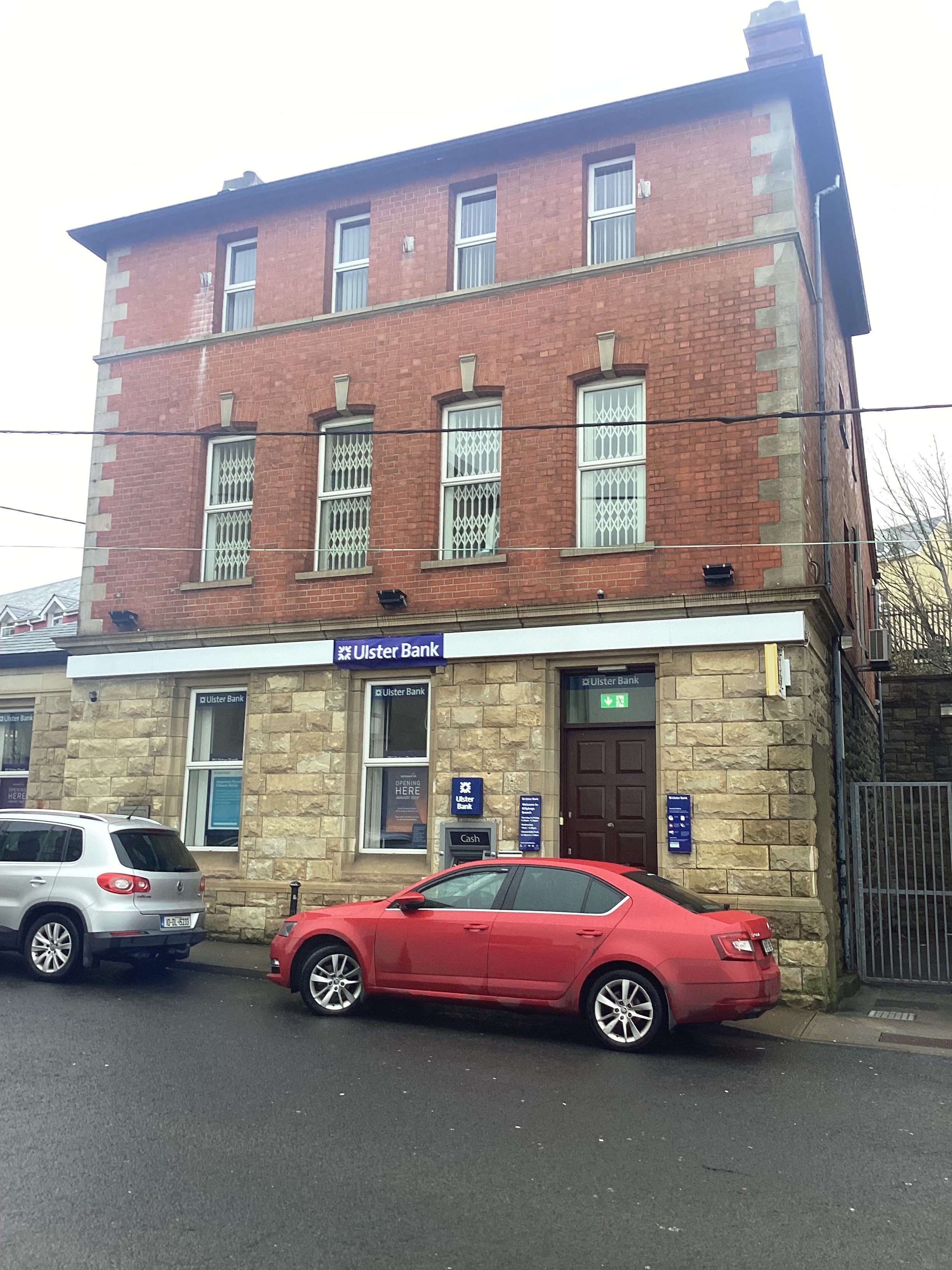
Although a fine enough structure, the building itself, with its city-like red brick exterior, was always out of harmony with the two-storey slated houses of the Terrace. It would appear that the bank prospered, although how profitable it was cannot be known. In what many regarded as a fishing town, the bank took the fishermen’s deposits but there was no question of them advancing money for a boat. This remained the situation for about 96 years, until the continuing success of the fishing industry forced the Ulster Bank to compete with other lending institutions.
There should be McGill descendants?
During the last century Irish death notices often contained the phrase ‘American papers please copy’. Well, here’s an upgrade to that: American descendants of the McGills please Google this blog, and let us know what became of that family in the U.S.
The family of Michael and Mary McGill:
Mary, Charles P., Joseph, Catherine Agnes & Annie Gertrude, twins, (Annie G. died in 1874), Ellen Jane, Michael James – (died in 1880, aged 4½), Eleanor Cecelia & Anne Gertrude, twins, Cornelius Francis & Teresa Gabriel, twins, Christina Margaret, Michael John.
The First Manager of the Ulster Bank, Killybegs.
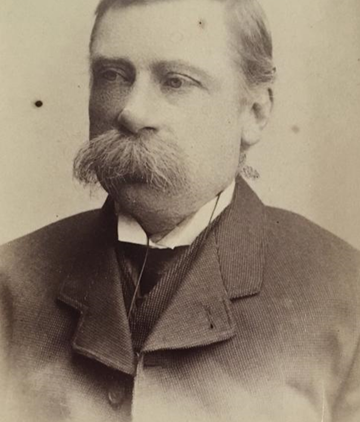
Thomas Clark Hope. Photo courtesy of Laura Hope.
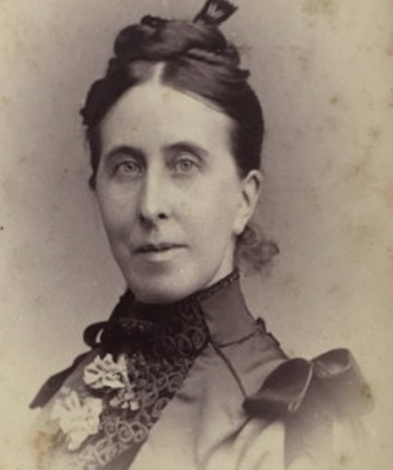
Emily Jane Hope. Photo courtesy of Laura Hope.
Thomas Clark Hope was born about 1837, and married Emily Jane Higginbotham of the same place, in St Anne’s Cathedral in 1867.
In November 1870 T. C. Hope was assigned to the new Killybegs branch from the Ulster Bank, Ballymoney. The Hopes arrived in Killybegs with two infants, Emily and Thomas, and rented Croaghlin House for their accommodation.
The Cashier was Stuart Cochrane, who was recalled to the Ballymoney branch in 1875. To mark his departure they held a dinner in Coanes’ Hotel (now the Cope House), where he was presented with a beautiful engrossed address. T. C. Hope gave the main speech of the night.
From 1872 Mr Hope was recorded as a Vestryman at St John’s church, Killybegs, and was appointed treasurer in 1884. His daughter, Emily, received the rite of Confirmation in the same church on 13th September 1883.
T. C. Hope retired as manager in 1898, and moved to a house in the Lough Head area. He died in a Dublin nursing home in 1901, just as the new bank building was under way. He was replaced as manager by J. F. Harris. In February 1899 a celebration was held to mark his retirement. During this event he was presented with a purse of sovereigns and an address by the Rev John Sweeney, P. P., on behalf of the townspeople:
ADDRESS AND PRESENTATION
TO THOMAS CLARKE HOPE, Esq.,
Late Manager, Ulster Bank, Ltd., Killybegs.
DEAR MR. HOPE – Your many Friends in Killybegs and throughout the extensive area in which you worked in your official capacity for twenty-seven years take the opportunity of your retirement from business to express to you their feelings of affection and esteem.
Some of us have known you during the whole of that lengthened period of service, whilst others of our number measure the time of our acquaintance with you from later dates; yet, be our acquaintances long or short, we have all experienced in your manner towards us, both officially and privately, the same courtesy and friendliness, accompanied by a manifest desire to oblige all with whom you had dealings to the utmost of your power; and we are gratified to learn that your services have been generously recognised by the Directors of the Bank.
It afforded us no small amount of pleasure to learn that, on retiring after your many years of service in the Bank, you had decided to settle down amongst the friends you had made in Killybegs.
May Almighty God, in whose hands are the issues of life and death, spare you for many years to enjoy your well-earned leisure. We ask your acceptance of this Illuminated Address, accompanied by a Purse of Sovereigns, which we feel are but very inadequate tokens of our feelings of goodwill towards you.
(Signed on behalf of the Subscribers by the Members of the Committee)
T. J. Hamilton Gorringe, J. P. Arthur Brooke, J. P.
Rev. W. Baillie, M. A., Rector. Rev. John Sweeney, P. P.
Dr J. W. Gallagher, J. P. John Rogers, J. P.
Samuel Cassidy, J. P. James Coleman, J. P.
Rev. H. St G. McClenaghan Rev. Michael Ward, C. C.
John Gunn Henry Judge
Patrick Conwell John Ward
William Houston John McGarrigle
Dr W. O’Donnell J. A. Thompson
Joseph Murrin John C. Ward
Patrick Dorrian John McGettigan.
J. F. Harris, hon. Treasurer
Charles Rogers, J. P., hon. Sec.
Killybegs, 13th February, 1899.
REPLY.
MY DEAR FRIENDS – Surely nothing can be more pleasing to a man in retiring from the work to which he had devoted his life than to receive such expressions of goodwill as those embodied in your Address from those amongst whom he had worked.
I value most deeply your kind words relating to myself and my work. I value your gifts far more on account of the feelings which prompted them than for their intrinsic value. It shall ever fill me with thoughts of pleasure to behold this beautiful Address and to read the very familiar signatures which are appended to it. These names placed beneath such terms of affection shall ever be before my mind and fill my thoughts with the faces and voices of very true friends.
It is indeed a matter of intense gratification to me that my new home and continued presence amongst you should give you pleasure. May He whose blessing you so tenderly and lovingly ask upon me make me daily more worthy of your kindness.
Your sincere Friend, THOMAS C. HOPE.
 killybegsbooks
You must be logged in to post a comment.