STORIES OF KILLYBEGS RAILWAY, PART 2.
The 130th anniversary of the Donegal-Killybegs Railway occurred in August of this year.
The First Train Arrives
We can be sure that the people of Killybegs were up early on the morning in August to greet the first train from Donegal. The press reported that about 400 people crowded on to the platform to welcome the new train. Some local people from Killybegs and ‘inside’ would have travelled on the first journey out of the station at 6 a.m. – the excitement must have been great. The names of the passengers were not recorded, and it seems that those who booked their seats on that first trip have faded from the folk memory. Only Edward McGuire of Lisnaclea and Teresa McGee (Bella’s mother) are spoken of as having bought two of the first tickets.
The press reported that:
The first train to depart Killybegs took on a fair complement of passengers anxious to enjoy the run along the shores of the lovely bay. All along the route were knots and groups of the country folk, waving handkerchiefs and other gear as they wished the passengers good luck, whilst many who hitherto had only had occasional glimpses of the steam horse stared with astonishment and wonder at the smoothly and rapidly running train, and the stations and platforms were well filled with local people brought there not only through curiosity, but to give a welcome to the first trippers.
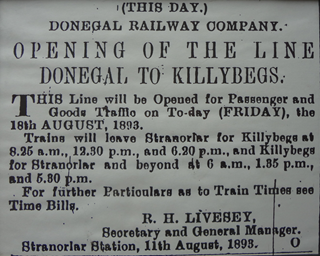
Above: Notice of opening of the line.
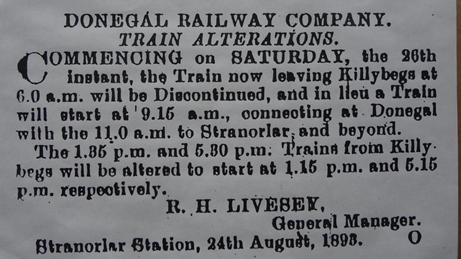
The 6 a.m. train must not have been very popular, because the time was changed to 9.25 a.m. within a week:
Father Martin and Balfour
The first part of this blog stated that the Chief Secretary for Ireland, Arthur Balfour, M. P., was responsible for allocating this new line to south west Donegal. It was given as a ‘free gift’ at a cost of £116,500. However the ratepayers of south west Donegal would be responsible for any losses. Profits had to be divided equally between the Railway Company and the Treasury.
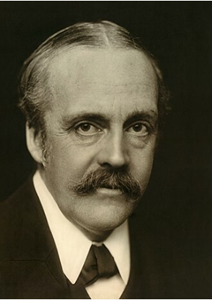
Arthur J. Balfour, M. P., Chief Secretary for Ireland.
Father Michael Martin, P. P., Killybegs, was the person who ensured that the railway came to Killybegs. To appreciate his efforts, it is necessary to know that Ardara and Glenties were also fighting for the terminus. These new ‘Balfour’ railways were intended to help the fishing industry by going right down to the shore at the ports. Killybegs was then regarded as a harbour where the Atlantic steamers would make a landfall, being nearer to America than Derry, Glasgow or Liverpool. Killybegs had a big influx of ‘stranger’ boats and curers during a big herring fishing, but it had no resident fleet of boats as in later years. Teelin and Inver had much better claims to the new railway, as fishing was the main activity in those ports. But Killybegs won out, even though it had only 19 fishermen according to the Census of 1901.
No celebration – just a meeting in Niall Mor School
It seems strange today to think the townspeople did not have some kind of celebration to mark the opening of the railway. There were no bands or banners, no flags or bunting. Part of the reason might be that there was no venue in town that would accommodate a large gathering. The Murray Schools on the Donegal Road were too small, and the Foresters’ Hall had yet to be built. Father Martin did decided to release a statement, and arranged for a public meeting to be held in the old Niall Mor School.
The Engine Shed
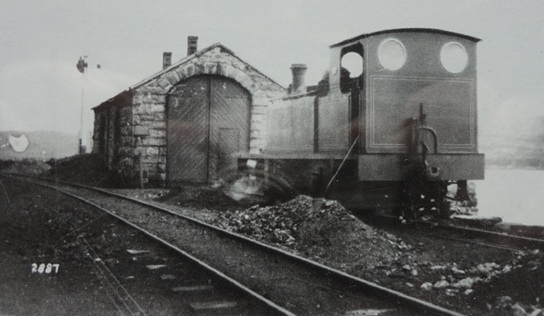
The engine shed and the ‘Meenglass’ engine. Photo courtesy of Jim McBride/Harold Eadie, CDRRS.
The engine shed at Killybegs where the steam engines were prepared for the next journey The shed was sited on the old ‘Murray’s Pier’ which was built in the 1840s for landing fish for curing in the White House yard. The shed was demolished in October 1957 by a runaway steam engine.
Below: Killybegs Railway Station Layout
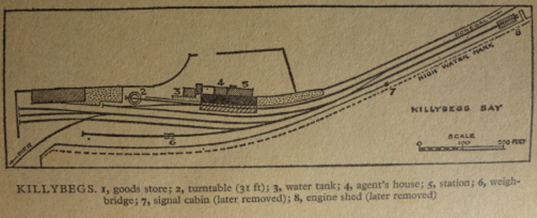
The layout of Killybegs Railway Station and tracks. The engine shed is at the top right.
Ardara Road Station
The Ardara Road Station was located at the Five Points, about 2½ miles short of Killybegs. Here the old road to Ardara was crossed by the railway line, and a crossing-house and gates had to be sited at that point. The first occupant of the gate-house was Jim Walker, a native of Carntullagh, who was listed as ‘Station master’, although it was not a station as such until later. The people of Ardara continued to press for a railway line to their town, but it was considered that such a line would not pay. Instead, they were facilitated by making the Ardara Road gate-house a ‘Stop’ from 1910, and building a goods shed there. Carters from Ardara could then transport flour, etc. from there.
One of the early excursions. St John’s Point Regatta, 1896:
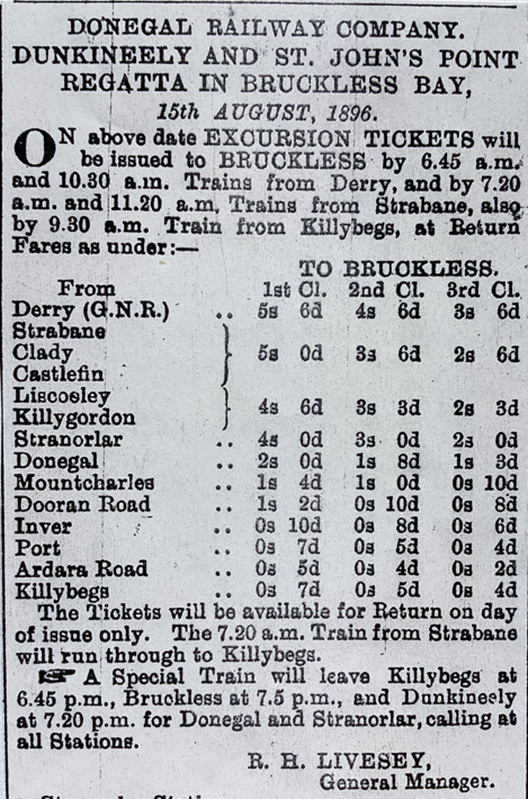
Third class train fare on the 9.30 a.m. from Killybegs to Bruckless Station was 4 pence in 1896.
 killybegsbooks
You must be logged in to post a comment.