
Stories of Killybegs Railway, Part 7
FATHER MARTIN’S BRIDGE
Next Tuesday, 23rd April 2024 is the 130th anniversary of the opening of Father Martin’s Bridge – a footbridge over the railway line near Killybegs.
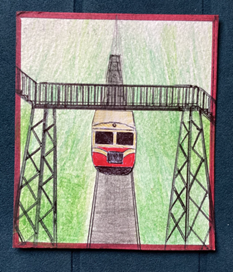
The railbus from Donegal approaching Killybegs
In days gone by people bathed in the clear crystal waters of Killybegs harbour.
A report in the summer of 1865 stated: Killybegs is par excellence, a watering place for a family of boys and girls. There are no bathing boxes for the latter, but there are plenty of nooks at a little distance from the town where a modest maiden can prepare for her bath, and the boys can have ‘headers’ into deep water……the harbour is so beautiful, the clear green waters washing the grassy hills which sink and swell and undulate and stretch down to the water’s edge.
In July 1878 James McLaughlin of Seaview, offered his house for rent, under the heading SEA-BATHING – KILLYBEGS. Seaview was the former O’Carroll home on St Catherine’s Road.
In June 1899 a correspondent wrote: …..the inhabitants (of Killybegs should) join together and take steps to remove seaweed, rough stones, and other rubbish off the beach, preserving the bathing boxes in a sanitary manner and in a proper order for bathers. But the exact location was not identified.
In the same month a visitor to the town wandered down the new wooden pier where a coal boat was about to arrive. He said: Prior to the arrival of the steamer numbers of longshore men argue in a loud voice about diving, and while some protest that the feats of the circus man that dives from a height of 70 feet into a shallow tank are the most marvellous achievements of the age, there are others who maintain that the performances of the little boys of Killybegs, who can dive off the end of the pier and pick up a penny from the bottom of the water are just as remarkable. (DJ 30 June 1899)
There were two places within the harbour where bathing was possible – the first was at the Smooth Point where the new south pier is situated. The Smooth Point was a favourite place for a dip but not suitable for tourists as the access was along the shore to avoid private land. However, bathing at the Smooth Point came to an end when the sewerage outfall pipe from the new Sanatorium was routed into the sea there in 1950. People will remember a large wooden notice erected at the low water mark at the Smooth Point, with OUTFALL painted on it. The other suitable place within the harbour was at a patch of sand on the shore below Carnaween House, at a place known as Cormie’s Rock. Carnaween House stands on this rock, which had to be cut back when they were making the Donegal Road in the 1840s, and again when the railway track was laid.
THE BEACH AT CORMIE’S ROCK, AND FATHER MARTIN’S BRIDGE
The beach below Cormie’s Rock was ‘opened up’ for swimming soon after 1886 when a new parish priest came to Killybegs. He was the Rev. Michael Martin, who was fascinated by the beauty of the harbour and its potential for tourism. He personally organised the clearing of stones and wrack off the small strip of sand.
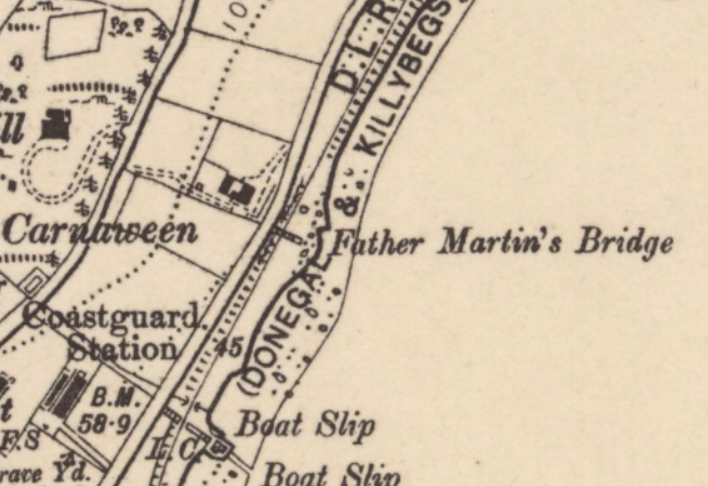
The location of the bridge, showing it crossing the railway
During these years people were encouraged to visit the seaside to avail of the bracing sea air and also to improve their health by swimming in the sea. It was an era when the long piers were built into deep water at the resorts on the south coast of England.
All was well until the railway arrived in the early 1890s. Everyone welcomed the railway as a great boon to the entire district, but it had its drawbacks. It is hard to imagine the disruption the railway caused in the tranquil village of Killybegs. The first thing the railway did was to fence off a strip of land next the shore where the tracks would be laid. No one could cross this fence on account of the danger of the speeding black monster – the steam engine with its wagons. This was the era of horse-drawn vehicles. The fence meant that bathers could no longer get to the beach, and the Coastguards were also prevented from running down to their Boat House at the shore. The only slipway in the town, located at the Diamond near the present Tara Hotel, was also blocked off. And finally the shore was filled in to create the Railway Yard. This yard was built up against the entire east side of the old stone pier, and fifty percent of the berthage was lost. The railway works cut off everyone from access to the shore, from the town out to Lough Head. The people were annoyed that their right of access had been taken away.
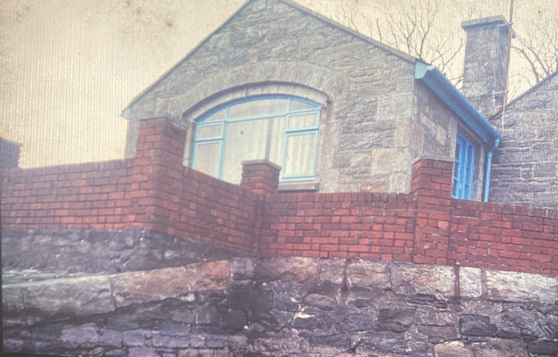
The former Coastguards’ Boatbouse, now a private dwelling
PUBLIC MEETING
Father Martin, being the leader of the community, called a public meeting in the old Niall Mor School. He maintained that the railway took away a public right-of-way to the shore which had existed from time immemorial. The PP imagined someone being drowned, and no way of getting to his rescue. The meeting heard that the Coastguards would be getting a gateway in the fence, and a set of stone steps to allow them to reach their Boat House. Some people thought that his would solve the problem of access to the beach further along, as the public might use that gate. It was pointed out that the gate would be locked, with the Coastguards having the key. (The Coastguards did get their access to the Boat House, but it was described as being by ‘steep and dangerous steps without side walls – an insult to the Admiralty’).
Father Martin suggested that the solution would be to build a bridge over the railway line at Cormie’s Rock. Prominent at the meeting were shopkeeper Owen Cunningham, great grandfather of Jimmy White, and Edmund Michael Ryan, who lived in St Kieran’s Cottage at Lough Head. (The one now being renovated). Mr Ryan proposed that an injunction should be sought to stop all further work by the Board of Works in the area unless a bridge was granted. This resolution was not carried.
No doubt a period of negotiations took place but the end result was that the Board of Works agreed to build a metal bridge over the railway line at Cormie’s Rock. It is not known who constructed the bridge, although it was erected by two men by the name of Mills. This is known because the local sergeant prosecuted Henry Mills and Henry C. Mills, as well as four labourers for working at the bridge on the 11th of September 1892, which happened to be the Sabbath. The case was dismissed by the local magistrates, one of whom was Captain Coleman.
OPENING OF THE BRIDGE
The bridge was finished in 1894, and formally opened on Monday the 23rd April of that year. The Ladies and Gentlemen of the town donned their best finery and gathered at the site at Cormie’s Rock. The opening ceremony was performed by Father Martin himself, who cracked a bottle of champagne on the bridge, and wished it long stability, with health and happiness to all who shall pass over it. Captain Coleman, R. N., proposed: That inasmuch as the bridge was procured for us through the influence and exertions of the Rev. Michael Martin, P. P., it be called the Martin’s Bridge in his honour.
Father Martin responded: Ladies and Gentlemen – I appreciate the great compliment you have paid me in recognition of my humble efforts to procure for you this bridge. I trust that the Donegal Railway Company will now improve the bathing places along the shore, and erect bathing boxes which would be patronised by the public. It should be their object to encourage bathers to come here, and it is quite certain they will not come back again unless they are able to get a good, safe, and pleasant bath in the salt water. The railway authorities have given us the bridge over the railway, but you see there is still something to be done to complete the way to the shore, which is steep and rugged. It now remains for you to add to it some stone steps, which can be done and will cost very little.
The entrance to the bridge was by two cut stone pillars, exactly opposite the steps leading to Carnaween House. A flight of steps led down to the flat surface of the bridge, and more steps continued down to ground level at the shore. A commemorative stone, executed by Patrick Quinn of Mountcharles, was inserted in one of the gate pillars; here’s the inscription:
| Erected in honour of The Rev. Michael Martin, P.P. Killybegs, Through whose exertion This bridge was obtained. 1894. |
The bridge was decorated for the opening ceremony by the Coastguards with a display of beautiful flags floating on the breeze. When the ceremony was over, a number of the men made their way to Rogers’s Hotel, where they celebrated the occasion by drinking the health of Mr Balfour, who sanctioned the railway when he was Chief Secretary.
THE 20th CENTURY
The Lough Head bathing place or Father Martin’s Bridge do not feature much in local stories of days spent swimming, so information on its existence in later years is hard to find. Marie Thornton, now living out of town, remembers that the town Development Association had a diving board erected below the Bridge in May 1950. This might have been to upgrade the spot on account of the Smooth Point becoming ‘out of bounds’ from that time. The locals continued to use the bridge for access to the beach up until the railway closed in 1959, and maybe for longer.
Between the Wars the Killybegs regattas sometimes included swimming races in the harbour. The 1930 regatta included a swimming race which was won by Charlie Breslin, with Jimmy Green second. (The Green family lived in the large house on New Row where Dr Martin had his dental surgery). In 1933 a swimming gala was held in the harbour, in which Jack Sweeney (mentioned in a previous blog) came second in the race for boys of 16 to 20 years of age.
Swimming contests were not a regular feature at the regattas, but there was another contest in 1960. In that year the adult swimming races were won by out-of-town people. In the junior section John Dick won the open race for under 16 boys; Desmond Sheridan came second. Thomas Dorrian won the novices race (for boys under 14), with Conal Gillespie second. Eileen Carr won the Ladies’ Open, with Maire McLaughlin second.
THE LAST MAN SWIMMING?
The last person to win a swimming race in the harbour was Frankie Murrin of Donegal Road, in the regatta of 1966.
Finally, the stone bearing the inscription and date of opening of the bridge has gone missing, although it is probably in some back yard about the town? Could this stone be found and made visible at some spot – it would be little enough recognition for someone who did so much for Killybegs?
 killybegsbooks
You must be logged in to post a comment.