
This month marks the 140th anniversary of the sinking of the British gunboat Wasp off Tory Island on September 18, 1884. Originally tasked with patrolling Ireland’s western waters to prevent smuggling, gunboats like the Wasp had largely become obsolete by the 1880s, as large-scale smuggling had declined. By then, smuggling was mostly limited to transporting poitín from small ports west of Killybegs across Donegal Bay to Sligo. As a result, vessels such as the Wasp were often repurposed, delivering relief supplies like oats and seed potatoes to the western seaboard during crop failures.
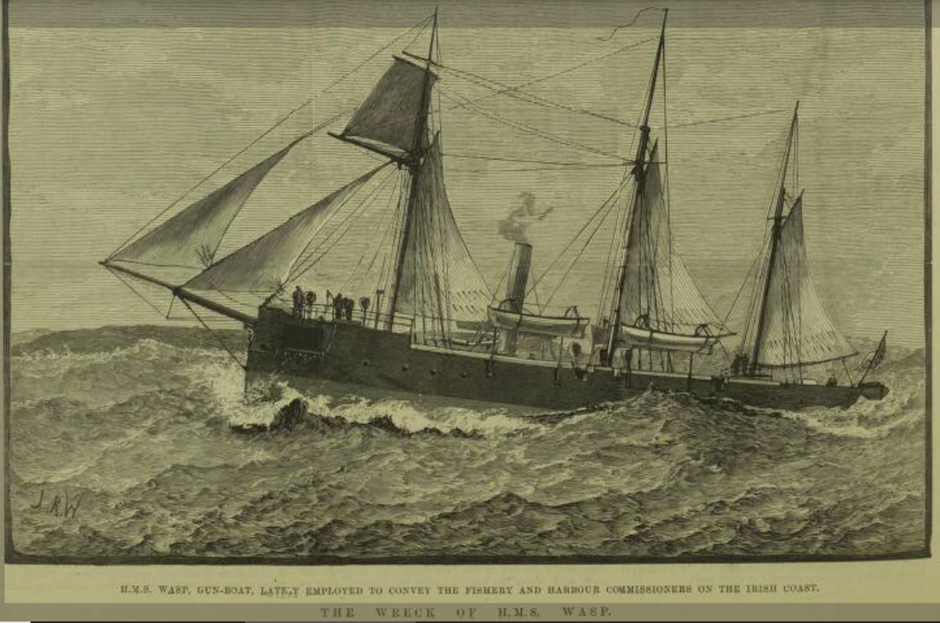
The Wasp under sail. Courtesy of the Illustrated London News
The folklore surrounding the Wasp in Donegal has always carried an anti-British sentiment, stemming from its mission to evict families from Inistrahull Island. In the spring of 1883, the ship had been involved in famine relief efforts, delivering Quaker-supplied potatoes to various ports along the Donegal coast, including two visits to Tory Island. The crew reportedly disliked this work, finding it laborious and unpleasant.
By September 1884, the Wasp was hired by the police to transport bailiffs to Inistrahull Island to carry out evictions. The sailors resented this task as well, with some stating, “They never joined the British service to do the work of an agent or bailiff.” It was during this mission that the Wasp struck a reef near Tory Island and sank, resulting in the tragic loss of 52 crew members. This catastrophe is widely known, so its details will not be recounted here.
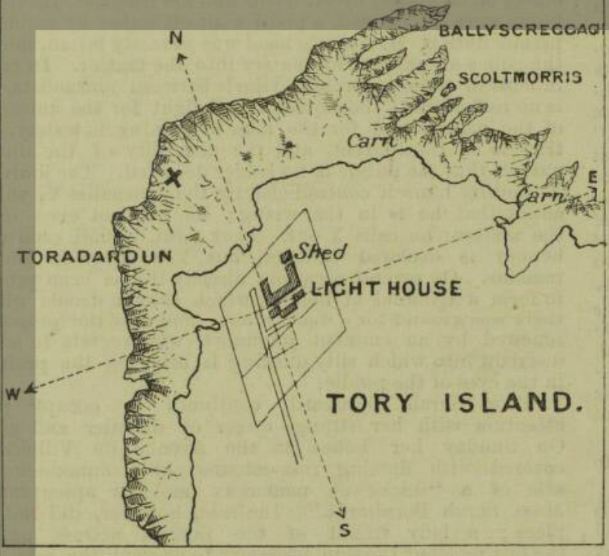
X marks the spot where the ship went down. (Image courtesy of the Illustrated London News)
The Wasp is connected to Killybegs through the marriages of three local women to sailors from the ship. In the summer of 1882, the Wasp docked at Killybegs, where Stoker David Flynn married 27-year-old Lizzie McGroarty. In 1883, another sailor, Fred Frost, married Jane McNelis. Lastly, just three months before the disaster, able seaman Albert J. West married Mary Cunningham in August 1884.
Another important figure with ties to Killybegs was Rev. J.J. O’Donnell, the parish priest on Tory Island at the time of the disaster. Previously the manager of Killybegs Industrial School and later the parish priest of Kilcar, Father O’Donnell played a key role in aiding the six survivors and providing spiritual care to those who perished. For his efforts, the British Admiralty acknowledged his “kindness and energy” during the tragedy. Father O’Donnell later passed away in Kilcar, where his headstone can still be seen outside the entrance of St. Cartha’s Church.
Lieutenant Commander Nicholls, the Wasp‘s captain, was among the victims. His body was recovered by Phil Boyle of Arranmore Island, who braved a heavy gale and rough seas to bring the captain ashore. Boyle described his efforts, recalling how he retrieved the naked body of Nicholls, who was likely on the bridge in his nightclothes when the ship went down. David Flynn’s body was later found washed ashore in Sheephaven Bay, while Fred Frost’s body was discovered on Innisbofin Island. Both men were buried in local graveyards. Their widows, Lizzie Flynn and Jane Frost, lived out their lives in Killybegs, passing away in 1937 and 1924, respectively. Mary West, who had married just before the disaster, died in 1936. Jane Frost had a daughter, Mary Jane, but she died at age 15
Rosses Fishermen Drowned
The sinking of the Wasp overshadowed another local tragedy: the drowning of two Donegal fishermen around the same time. On the evening before the Wasp disaster, three Rosses fishermen—Morgan Sweeney, John O’Donnell, and Hugh O’Donnell—went to sea to retrieve their lobster pots amidst a brewing storm. After lifting the pots, their boat struck Carrickaphlanda rock and sank. Hugh O’Donnell swam to safety, and was cared for by William Griffith of Termon House. Morgan Sweeney and John O’Donnell perished. John’s body was found the next morning near the wreck, and Morgan’s body was recovered a few days later.
 killybegsbooks
You must be logged in to post a comment.