
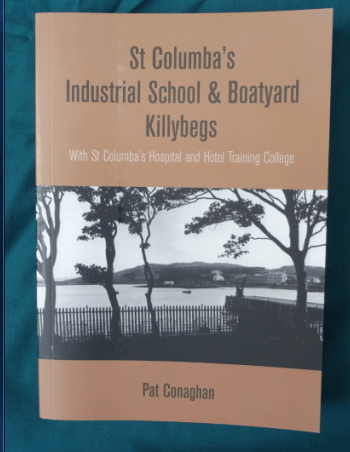
You couldn’t get a better present than this. Available at the Killybegs Information Centre on Shore Road, Four Masters Bookshop, Donegal, Eason’s, Letterkenny.
You couldn’t get a better present than this. Available at the Killybegs Information Centre on Shore Road, Four Masters Bookshop, Donegal, Eason’s, Letterkenny.
It is already known that the new town of Killybegs was founded by Charter of King James VI, dated 14th December 1615, in the 13th year of his reign.
The man chosen to build the new town was Roger Jones, then Sheriff of Sligo. Jones was a wealthy merchant and he was ordered to finance and oversee the building of the first houses in new Killybegs. The plan was that the king, who was always strapped for cash, did not have to spend anything on this new settlement. The town was managed by Jones and a group of picked gentlemen, who set themselves up as the Provost and Corporation of Killybegs, thereby giving (English)) legal status to the town. Jones was made Provost, and it is known that he occupied one of the first houses, although the site has not yet been identified. Jones had been granted a narrow plot of land for the town, adjoining the north shore of Killybegs harbour. This site extended from the ‘Bridge River’ eastward to the second by-road beyond the Commons School. A dispute over the ownership of this land meant that Jones departed Killybegs some years later, and he died in Sligo in 1637.
He was buried in St John’s Abbey, Sligo, and an elaborate gravestone, depicting Lady Jones and himself, was placed on his grave. Unfortunately the graveslab was badly damaged at a later date, and part of Jones’s image was lost. The fragmented stone is located today in the Cathedral of St Mary the Virgin and St John The Baptist, in Sligo.
While Jones, through his business interests, helped to establish Sligo town as a large trading centre, he appears to have had no influence on the development of Killybegs.
The priceless assets of a deep-water harbour and an abundance of fish were exploited by foreigners who used Killybegs as a base for fishing and processing. Government agencies such as the CDB, SFA, BIM and the IDA, supported the development of the industry for most of the 20th century. But it was not until private investors took control of the economics of the industry that the prosperous town of Killybegs emerged from the industrial darkness of the North West.
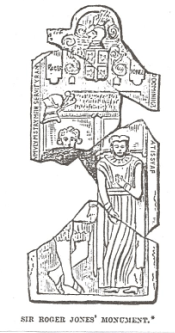
THE BROKEN GRAVE-STONE DEPICTING ROGER JONES AND HIS LADY.
It would be appropriate if a memorial to Roger Jones were to be commissioned and erected in Killybegs at this time, using a modified version of the above stone.
TOURISM
An article in the Press in 1929 described Killybegs as a great tourist destination. One of the sights to be seen, it was said, was the Rocking Stone in Faiafannon:
The Rocking Stone of Faiafannon, about two miles from the town, should not be missed. The huge stone, delicately poised on a rock, is capable of being moved without the slightest danger of being disturbed from its resting place. Strangers may have difficulty in providing the motion, but those who are familiar with the stone usually succeed in producing the swaying movement which gives it its name.
During the depression years of the late 1930s there was very little employment in Donegal. Work was created by the Government via Minor Relief Schemes, for example, the opening of extra roads in country areas, or repairing roads that did not really need much repair. One such scheme was started in the townland of Faiafannon, where, in November 1938, thirty men were provided with work, under the supervision of John McBrearty, Island. The purpose of the scheme was to build a new road to the Rocking Stone, or Wishing Stone, as some called it. Killybegs folklore stated that Finn McCool threw this rock from Connaught, although what made him so mad is not recorded. The new road was completed just before Christmas in that year, the scheme providing many households with badly-needed cash during the darkest time of the year.
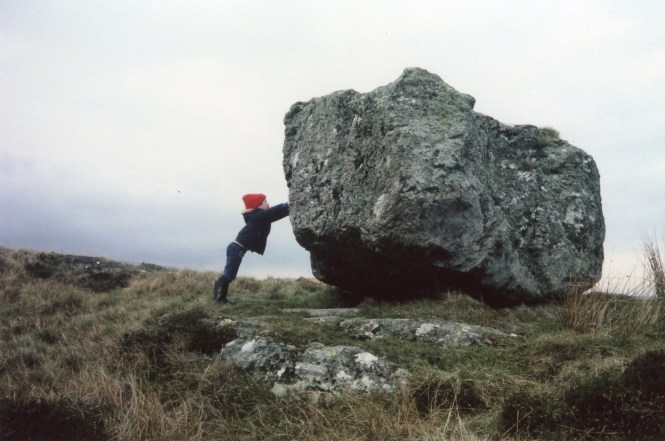
The Rocking Stone at Faiafannan, Killybegs.
THE HOMECOMING OF PATRICK DORRIAN AND HIS BRIDE
A very pleasant scene was witnessed in the town of Killybegs on Thursday night, 15th January last, when Patrick and Mrs Dorrian returned to their home after a protracted wedding tour. Mr Dorrian is well known in the north-west, as the respected senior partner of Dorrian Bros., Killybegs. When the date of the homecoming was made known in Killybegs the inhabitants determined to give their popular and patriotic fellow townsman and his charming bride a reception worthy of the respect and esteem in which they are held. Willing hands soon provided the material, and long before the train was due, many huge bonfires were in readiness awaiting the match. Headed by a band, the crowd adjourned to the railway station, and there awaited the happy young couple’s arrival. As the train steamed into the station amid an explosion of dozens of fog signals, the discharge of firearms, and the deafening cheers of the crowd, the scene was one long to be remembered. On alighting from the carriage, Mr and Mrs Dorrian were the objects of fresh outbursts of cheering, again and again renewed. It was a considerable time before anything like order could be restored. However, at last a start was made, the happy couple leading the way and the band following playing enlivening tunes, accompanied by a number of torch bearers and fully three hundred townspeople, each one bent on showing the esteem and popularity of Patrick and Mrs Dorrian and their approval of the of the reception accorded them. On arrival at the rooms of the Catholic Young Men’s Association, of which Mr Dorrian is the president, the members turned out en masse, cheers were given again and again, hats and handkerchiefs were waved, and amid the singing of He’s a Jolly Good Fellow, they joined the procession, and all continued the way to the residence of the bride, where Mr Dorrian, in a few well chosen words, returned the thanks of himself and his popular bride for the reception given them. He said that words failed to give adequate expression to his sentiments, but he could promise that it would be long before the events of that night would pass from his memory. His remarks were greeted with ringing cheers and shouts of Your are worthy of it. Refreshments on a liberal scale were provided, and while the people were enjoying the good things the happy couple moved about among the guests, receiving the congratulations and good wishes of all present, a choice selection of music being meanwhile rendered by the string band. About ten o’clock the crowd quietly dispersed to their homes, well pleased with the way in which they had spent the night. It is worth mentioning that the rooms of the CYMS, as well as most houses on the route from the station, were beautifully illuminated with coloured and other lights. (19 January 1903)
ST CATHERINE’S WELL TODAY (1955)
The Holy Well of St Catherine, situated on the side of a conical hill on which stands the ruins of Kit’s Castle, once the residence of the bishops of Raphoe, is still a place of daily pilgrimage. The sparkling water gushes from the limestone rock, and forms a pool which, overflowing, trickles down the hillside to the sea. There, on November 25th – St Catherine’s Day – the people of Killybegs and neighbouring parishes come from dawn to midnight in a constant stream, to pray. They climb the hill, and move reverently round the well, deisealach, doing the turas, rosary in hand. They sip the water that was blessed by some holy men in homage to St Catherine perhaps fourteen centuries ago.
(Written by Charlie Conaghan, in the Donegal Democrat, 20 February 1955)
TO BE LET, furnished, Croaghlin House, Killybegs, containing Drawing-room, Dining-room, Five Bedrooms, Kitchen, Pantry, Garret. Beautifully situated close to the Sea. Excellent Bathing. Within a Mile of Killybegs Railway Station. Terms Moderate. Apply to the Rector, Industrial School, Killybegs. (9 May 1902)
DONEGAL ASSIZES – CROWN COURT
Michael Gillan stood indicted for shop-lifting in Killybegs, March 1840.
Majee Driscoll sworn as witness – keeps a small shop in Killybegs; there are some wooden panes in the window; they were forced in at night, and a quantity of her shop goods taken away; saw the goods afterwards.
Sergeant O’Brien sworn as witness: Found the goods at Ardara and other places where the prisoner brought them to.
Guilty. To be transported [to Van Diemen’s Land] for ten years.
In the days before RTE we had to watch a lot of snow on the TV screen. Jack Murchan’s telly, when he lived up in the Braes, had a miraculous picture from UTV, but in the town all you had was a faint shadow behind the snow. We told ourselves that the snow was beautiful – what else could we do? Before that Paddy Sharkey had rigged up a TV in his house on Conlin Road. This report from the Democrat of 14 August 1953 recorded the historic occasion:
Mr Patrick Sharkey, wireless and electrical engineer, has installed a television set at his residence, Conlin Road, Killybegs. Apart from a little fading out at times, results are considered satisfactory.
It has been said, with some truth, that this blog is not that lively; indeed it could be described as dull and sometimes uninteresting. So, to give some balance, there will be a departure from the usual doom and gloom to a different variety of gloom and doom.
The blog has no wish to promote what may be called shocking events of a tabloid nature, but sometimes life is not a bed of those plants with thorny stems that grow in gardens. Shocking things happen, and there is no harm in reporting them, it might even serve as an advance warning to vulnerable people.
From time to time the media carry reports of robberies committed on elderly and defenceless people in remote areas. Terrible as these incidents are, they have a long history, as this report from July 1851 shows:
ROBBERIES AND OUTRAGES
Since the month of February, not less than thirty six robberies have been committed within two miles of Letterkenny, and not a single detection, save in one instance, although most of them were of a very serious and aggravating nature. You cannot travel out almost any distance in any direction without meeting some party either going to the doctor to have their wounds dressed. Or people enquiring after some stolen property, horse or cow, meal, money, bed and back-clothing, or other effects of which they have been plundered by these daring and heartless robbers. One man is lodged in Lifford gaol at present, for being one of the 18 who came by night to the house of an unprotected widow and her son, and a relative who was as servant in the house; When the robbers had broken down their strength so they could offer no further resistance, and that they might not recognise any of the party afterwards, they bound their clothes around their heads, and their arms with ropes, and threw them all into a bed, shutting up the apartment. This done, they struck [lit up the lamps], kindled a fire, and collected all the butter, milk, eggs, and bread in the house. On this they feasted for one hour without any apprehensions of danger, no neighbours being near. When this scene was over, then the work of plunder commenced. One party collected all the linens, sheets, back-clothes and bed-clothes, all the knives and forks, etc. Another party collected the sacks, and filled them with meal, not leaving one pound behind. Another party loaded their own horses first, and then broke open the stable door and took out a horse to carry off what remained. They left the widow’s house a complete waste, herself, son, and servant, bound with ropes, full of large wounds. They were bleeding profusely, and rolled up as they believed in their bloody grave-shrouds, without a single article of food or raiment, should they ever require it. Indeed “so cruel” relates the aged widow, who survives, through greatly disfigured from many large wounds on her face and other parts of her person “was the human monster, who inflicted on her all her sores, that when he had broken down her strength, that she could make no further resistance, and was in the act of binding her with ropes, he stooped down and chewed off part of her nose with his teeth”.
On Thursday, 23rd July, 1896, Mrs Gorringe, wife of the Fintra estate owner, laid the foundation stone of the new clock tower and stables. The evening was given up to a supper, followed by music and singing for the estate workmen, the constabulary, and the Killybegs railway staff.
As landlords the Gorringes kept on good terms with their Fintra tenants. The Fintra estate was made up of the townlands of Coolnagoppoge, Gortnamuck, Gortnagolan, Tullig, Island, and Lisnacleha. The 90 tenants of the estate paid rent to their landlord, T. J. Gorringe.
Having built new out-offices, including a meeting hall, Gorringe decided, in 1896 to add an ornamental tower, which would include a clock, and be surmounted by a weathervane. He arranged a formal laying of the foundation stone, and at the same time, threw a party for his tenants.
The celebrations started on Monday, July 20th, 1896, and lasted over three days. On the first evening he invited all the elderly or principal tenants. They all sat down to a feast of beef, mutton, and vegetables, followed by plum pudding, and whiskey or water to drink. The ladies of the manor had decorated the dining space with bunting, evergreens and plants. These women were Mrs T. J. Hamilton Gorringe and Mrs Twigg, helped by their daughters. (Annie Wilhelmina Hamilton of Fintra House married John B. Twigg of Dublin in September 1866).
During the speeches which followed the meal, a toast was made by Mr McGinty, who proposed the health of the landlord, wishing him health and prosperity. Mr Gorringe, returned thanks to McGinty and the Fintra tenants. He said he was very pleased and delighted to meet them all on such an occasion, and hoped in the future he would have the pleasure of meeting them all there again.
James Hegarty then proposed the health of Arthur Parsons-Guy, the agent to the Fintra estate, speaking well of his energy and interest in the welfare of the tenantry. Guy, responding, said that a better lot of tenants than those on the Fintra estate he could not do business with; he always found them honest. He was proud to say there were very few arrears on the estate, and by next year he hoped to see everyone clear.
The toasts over, the evening passed off very successfully with singing and music, the latter aided by a large musical box placed on the platform of the hall.
Pipes and tobacco were provided for the men, and for any of the old ladies who indulged in the nicotine habit, while several accepted the packets of snuff from Mrs Gorringe herself.
The following evening the sons and daughters of the tenants, numbering 102, came in for their share of the festivities. Tea was laid on in the hall and afterwards the tables were removed and dancing began. The music was provided by two violinists specially hired from Strabane, and dancing was kept up till 3.30.a.m. During the evening the whole frontage of the residence was brilliantly illuminated with hundreds of fairylights, and a display of fireworks was given, to which all the neighbourhood was invited.
Finally, the foundation stone, with a suitable inscription, was laid by Mrs Hamilton Gorringe. Underneath a hole was cut, and papers of the day and coins of the year were placed inside.
On the Saturday afternoon the gala week concluded with a tea and magic lantern entertainment, to which all the little children on the Fintra estate were invited.
 killybegsbooks
You must be logged in to post a comment.