The 17 chapters of the book are set out as follows:
Chapters one to ten deal with the setting up and the building of the Industrial School. The early chapters cover the background to the establishment of the School, and go on to describe the committal of the boys, their circumstances, and staff and conditions within the School.
The more extensive records of the last ten years of the School allow a detailed picture to be built up. This is done using the bills of quantities of food and materials that were supplied on a regular basis.
The First World War and the the Irish ‘troubles’ during the 1919-22 period put pressure on the day to day survival of the School, and it was necessary to take decisive action to keep it viable. Two schemes were devised to assist the School and its boatyard to survive that difficult time. These were the establishment of an electricity generating plant at the Boatyard to provide electric light to the town on a commercial basis. The other one was to activate the ‘McDevitt bequest’, a sum of money bequeathed to the Bishop of Raphoe for educational purposed in the diocese. The origin of the fund was the profits made by of Hugh and Charlie McDevitt of Glenties who ran a knitwear business. Part of this fund was used to assist the boatyard in training boys in boat construction and later in other trades.
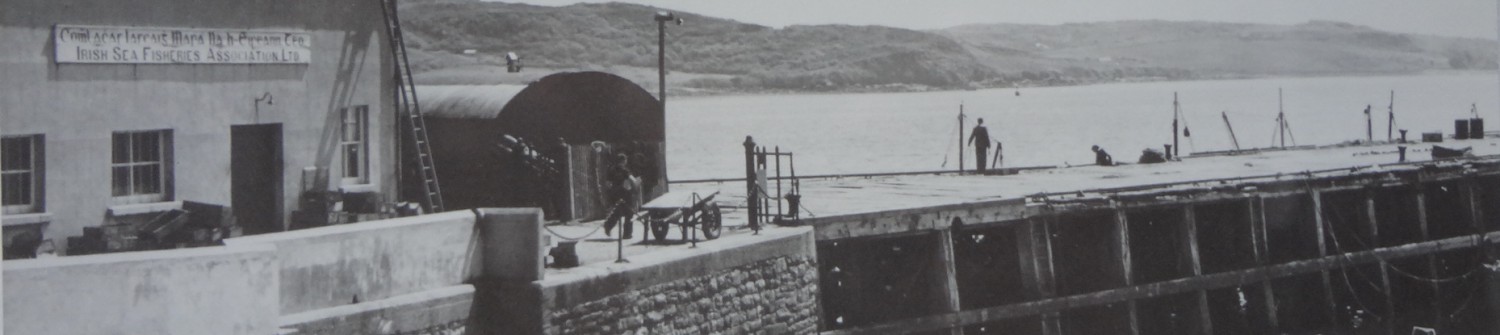
The installing of a Lighting Plant at the Boatyard was done at the end of a period when all the towns were setting up similar plants. The townspeople were canvassed to see how many would take the new light, and when a certain number had ‘signed up’ the plan was put into motion. A large number of poles had to be brought in, and the town and houses wired. Many will remember ‘pole no 1’ which was sited on a plinth in the harbour just above the Boatyard. The Killybegs scheme was switched on in 1925 and on the same evening as the town was illuminated they held a celebratory concert in the Industrial School. This concert featured many of the townspeople, and details of the artistes are given in the book.
The Second World War brought a sudden end to Killybegs Industrial School because the Irish Department of Defence took over the School and garrisoned it with units of the Irish Army. It is not easy to disentangle what was going on between Ireland, Britain and Germany in the first years of the War but the Irish Taoiseach, Eamon De Valera, kept Ireland neutral. In dealing with the bigger nations De Valera had to carry out a delicate balancing act to avoid Ireland being used as a pawn in the wartime power games. The sending of the Army to Killybegs can therefore be seen as a gesture to keep Britain on side, and not necessarily as a strong defence for the west coast.
The School was opened to the Red Cross shortly after the War ended to provide accommodation for German children, many of whose parents had died in the conflict. Personnel of the Killybegs branch of the Red Cross assisted in this humanitarian effort.
The next chapters of the book deal with the purchase of the Industrial School building by Donegal County Council and its conversion to a TB sanatorium. Joe Cunningham of New Row, Killybegs was awarded the tender for the conversion but died shortly after he began the work. Dr Ronnie Clarke and his staff ran an enlightened regime within the hospital, with the result that 99% of their patients regained full health. The the new antibiotic drugs were coming on stream and these also contributed to the curing of TB in very many patients.
The struggle to obtain the building for a Hotel Training College occupies the next section of the book although the success of this institution merits a book all to itself, perhaps now that its 50th anniversary is approaching.
Thirty five Appendices at the end of the book give additional information on the people covered in the preceding chapters. This section also contains a breakdown of all the boats launched by the Boatyard since its foundation.
The index of persons is set out on the last pages of the book, and an index of the Boatyard boats can be seen on this site.
Return to book. killybegsbooks