
STORIES OF KILLYBEGS RAILWAY, PART 3.
The 130th anniversary of the Donegal-Killybegs Railway occurred in August of this year.
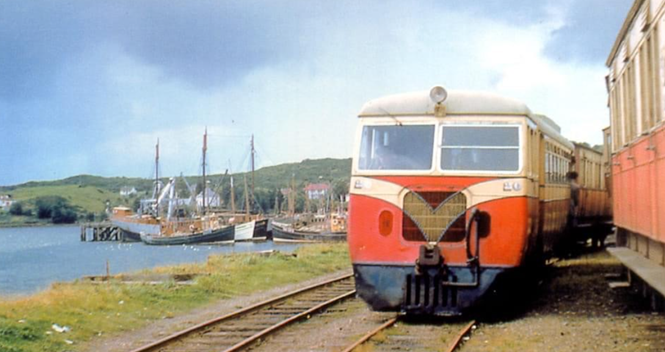
Railcar No 20 leaving Killybegs between 1957 and 1959
Different Routes Proposed for the Line
In the years prior to 1893 the people of Glenties, Ardara, Killybegs, Inver and Kilcar fought to have the railway laid to their area. The three main proposals were: Donegal direct to Killybegs; Donegal to Killybegs, with a branch at Inver leading to Ardara and Glenties; and Donegal to Killybegs via Glenties and Ardara.
The direct line from Donegal to Killybegs was finally pushed through, and the rest is history. When the route was agreed, Father Michael Martin, parish priest of Killybegs, persuaded Arthur Balfour, Chief Secretary of Ireland, and ‘provider’ of the railway, to allow work to start on the line even before any contracts were signed.
At the end of 1890 the line was marked out and lockspitted, and the fencing began. The late Bertie Boyd of Tullaghacullion said that his father ‘drove every fencing post’ along the route. These posts, and later the sleepers, were provided by John Gardiner, who had a steam sawmill at Mountcharles.
By early January 1891 over 150 men were employed, and excavation of the earthworks along the route was well under way. The folklore of the area indicates that men who lived at a distance from the line would sleep overnight in barns and outhouses – this in the depth of winter. Even so, the clergy and policemen were urging the gangers to employ extra men. At Seahill, Dunkineely the line had to be bridged over the Burnlacky River, and the ground filled at each side. For this work, temporary rails were laid and earth-carrying vehicles used to transport the filling. Twenty four wagons, with suitable rails came into Donegal Railway Station and were transported to the Seahill site to move earth and stones for the works. On Sundays people came from long distances to have a close-up view of the works.
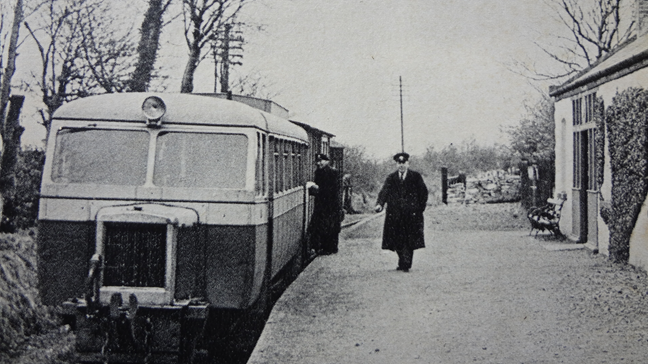
Guard Tommy Kenny and driver Cahir Kennedy at Dunkineely Station
TERRIBLE ACCIDENT ON THE KILLYBEGS RAILWAY
A MAN BLOWN TO PIECES – SEVERAL INJURED.
On Saturday evening, 4th April 1891, shortly before quitting time, a terrible accident occurred on the railway works at Castlereagh, midway between Bruckless and Killybegs. A man named John McDaid, a native of Keelogs, Inver, was instantaneously killed and several badly injured. The men were blasting rock with dynamite, and had nine charges set. Eight of the charges went off, but the ninth missed. They thought that all the charges had gone off, and despite warnings from the ganger, the men approached the workface again just in time to receive the full effect of the ninth charge exploding. McDaid’s head was severed from his body by a clean sweep, and his brains and portions of his skull scattered in several directions for thirty yards. William Hamilton, 20, of Tullaghacullion, had to be carried home. His wounds which were stitched by Dr Gallagher, Killybegs, and Dr Pollard, Dunkineely, extended from the mouth down along the throat to the chest. The chin was greatly mutilated. John Gallagher had his jaw bone broken, and one of his cheeks and eyes shattered. Rev. John Doherty, C.C., administered the last rites to him. Four others, O’Donnell, Harkin, Herreran, and McCallig, were also injured. Medical aid arrived quickly to attend to the relief of the injured, but the situation looked hopeless for Gallagher, who happened to be a neighbour of McDaid. These two men were lodging in the house of William Buchanan, Castlereagh, to which the deceased and Gallagher were taken after the accident. Rev John Doherty administered the last rites to Gallagher. He also visited the other sufferers.
Local feeling was strong against Harkin, the ganger, on the grounds that he should have been more careful. He was arrested by the police. But it seems that that the inexperience of the victims in the use of dynamite was to blame for the occurrence.
In July William Hamilton took an action for damages against Dixon the contractor. Describing the scene of the accident, he said: ‘We were blasting on the railway works near Killybegs. After one charge had been fired the men went back to work, and some undischarged dynamite exploded. The plaintiff wore blue glasses when giving evidence, and his lower jaw bore traces of the injuries. He said that Frank Gallagher, who was known as ‘the blaster’ put several cartridges into holes in the rock prepared for them. The workers then took cover and Gallagher put a fuse to the cartridges. The charges exploded and the men were ordered back to work by a ganger named Harkin. About half an hour later when they were working away with picks, another explosion went off. McDaid was killed. He believed that himself or McDaid must have struck the unexploded cartridge with a pick. Later he went to the eye hospital in Belfast where one of his eyes was taken out. Dr Gallagher, Killybegs, gave evidence as to Hamilton’s injuries. The doctor’s fee for attendance was twenty guineas. The jury found against Hamilton but ‘recommended him to Mr Dixon’s consideration’. He was later employed as a porter on the railway. John McDaid left a widow and seven small children to mourn him. She eventually received about £80 from private and public sources.
Mountcharles man injured (1)
On Friday 20th March 1891 Patrick Byrne, of Mountcharles, a Hackman at a cutting near Mountcharles on the Donegal to Killybegs line, was working at the bottom of the excavation. The sides were undercut, and suddenly a large heap of earth fell from the top, almost burying the unfortunate man and the pick with which he was working. The force of the falling clay came against his leg and broke it. The labourers at once proceeded to dig away the earth, and had him extricated and removed as quickly as possible. Dr Smith set the leg, and the poor man was removed on a cart to the Donegal Infirmary.
Mountcharles man injured (2)
Ten months later, on Monday 25th January 1892 a young man named William Campbell, employed on the railway works at Mountcharles, was badly injured. His job was to remain behind on the wagon filled with clay from the cutting to the tip-head. Before the wagon reached its destination, and while going at high speed, it tipped up, throwing Campbell right over the waggon. He fell heavily on his chest on the rail and sustained serious injury. It was some time before he could rise. The accident occurred owing to the rails not being level at the joint, one being high and the other low. The injured man was assisted home in a very precarious state.
 killybegsbooks