
According to Rowan’s ‘Architecture of North-west Ulster, the Church of Ireland church in Ardara was erected in 1833. The first bell was installed in 1845, and repaired in 1954.
Most of the surrounding parishes had built new churches in the 1820s and 1830s by way of loans provided by the Board of First Fruits, but evidence that Ardara availed of that assistance is hard to find.
By 1877 the local Vestry had decided to carry out repairs and additions to the church, but it is doubtful if this took place. However, by the turn of the century extensive repairs were needed, so an ambitious plan of renovation was decided upon. Early in 1906 tenders were sought for the proposed works:
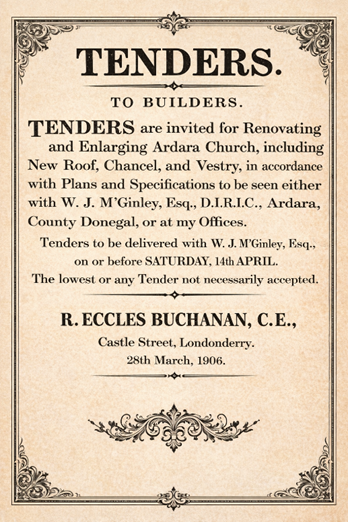
The tender was awarded to John Bloomfield of Fermanagh, and the work commenced early in the same summer. It so happened that Robert French, the lead photographer of the famous William Lawrence company, visited Donegal at that time, to take some views for the postcard trade. A few of his photos of Ardara survive; two of them showing the church under repair:
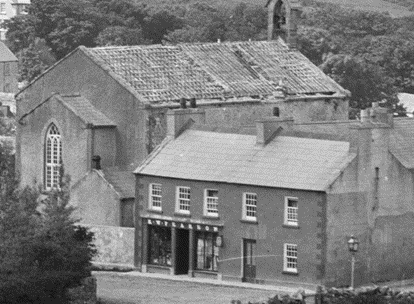
Looking south-west, showing the old slates removed. Pearsons’ grocery and hardware shop in the foreground. (Photo courtesy of the National Library of Ireland, Lawrence Collection)
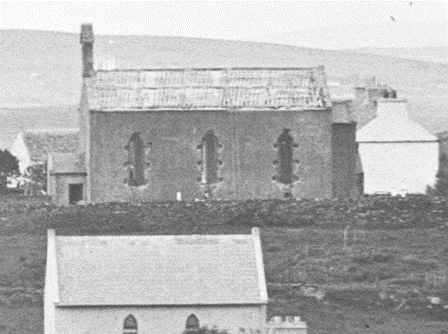
The church, from the south, with old windows removed. (Photo courtesy of the National Library of Ireland, Lawrence Collection)
The renovations were completed in October, and the re-opening took place on Sunday the 7th of that month. The Press reported that:
Reopening – Sunday 7th Oct 1906
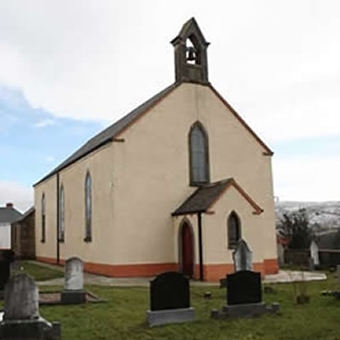
The Lord Bishop of Derry and Raphoe and the Ven, the Archbishop of Raphoe preached at the reopening services of Ardara Parish Church, and there were at both services large and deeply interested congregations. The renovations have been effected with great success by the contractor, Mr John Bloomfield, Brookeborough, county Fermanagh. The improvements, involved the remodelling of the building, and equipping the parish with a church of neat and artistic appearance and much comfort, a result on which both the rector (Rev. A. Knight) and the parishioners deserve to be congratulated. The outer walls were lowered and a new, open timbered roof provided. The interior has been wainscoted in pitch pine. The lowering of the windows was also part of the scheme, and the filling of them with leaded lights in cathedral tints has heightened the pleasing artistic effect. The aisle has been laid down in encaustic tiles of pretty pattern, and a new chancel arch gives grace and dignity to the interior. The seats were repainted and rearranged and the walls coloured. A number of generous gifts have marked the reopening. An oak Communion table was given by General Tredennick, D. L., and a handsome lectern by Rev. Arthur McQuade, and two friends; Mr William Burns and family presented a flagon in memory of a little son; the oak hymn-board was a gift from Mr Harry Spence; Rev.lk A. G. Stuart, Bogay, gave the oak font cover; and Messrs J. J. Pollock & Co., Londonderry, the linen tablecloth and napkins, while the prayer-book and office-book were the gifts of Mrs R. D. Buchanan and family in memory of their mother; a Bible for the lectern was presented by Mr G. Cunningham; and the chancel oak chairs were presented, one by Mrs G. Cunningham and the other by Miss Ellen Baskin and other members of the family, in memory of their father and mother. The money for the handsome set of suspension lamps of 100-candle power was collected by members of the choir – Misses McGinley, hon. Secretary and treasurer, Burnside, E. and M. Spence, M. Strong, and B. Baskin. The parishioners subscribed generously to the improvement fund, and gave most of the drawing and labour free. The morning service began with the consecration prayer, with the proper psalms and lessons. The Rector read Morning Prayer, the Archdeacon of Raphoe read the lessons. Miss Christie was the organist, and the choir sang with sweetness and expression. The Lord Bishop preached from Hebrews xi, 1., after which he said: ‘…. And I thank God for your faith and love, shown in the marvelous transformation of this place since last I was among you, in the help which others have given you, but much more in the large and splendid generosity of the rank-and-file of this little parish, who have done beyond what we could have hoped or asked from them’.


You must be logged in to post a comment.