Stories of Killybegs Railway, Part 5.
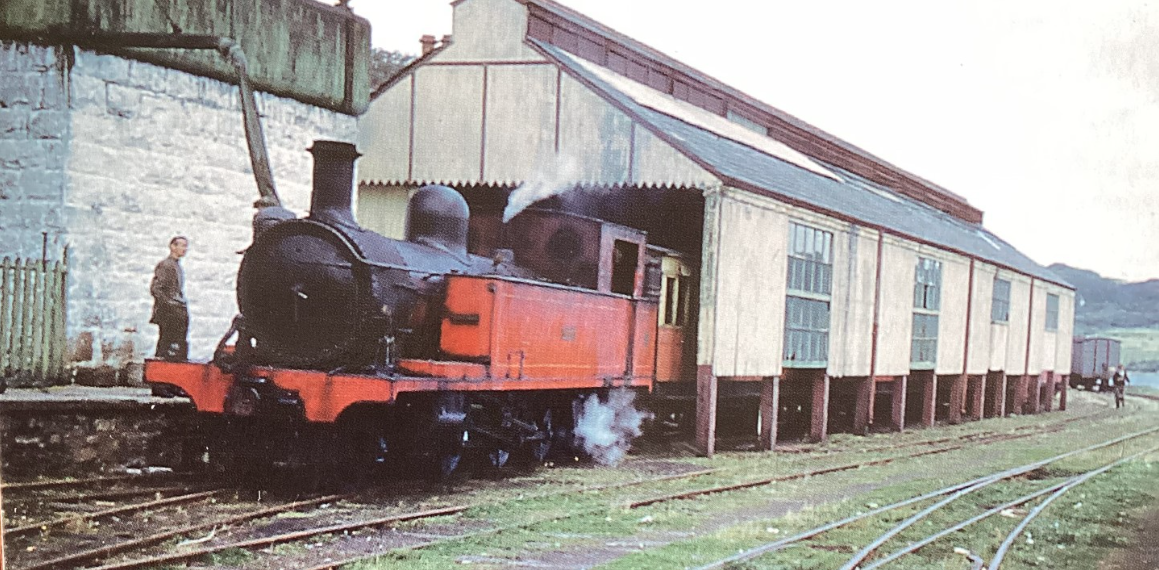
A locomotive being topped up from the water tank at Killybegs station, with Frankie McMenamin looking on. The other figure is not known. Frankie was a son of Frank McMenamin, who is listed below.
It would be difficult to name all the railway people who ran the Donegal to Killybegs line, or even those who worked the trains from Killybegs. Below is a necessarily incomplete list of those who dedicated their lives to the working of the line.
KILLYBEGS RAILWAY STATIONMASTERS
1893: Paddy Martin
1899: J. Hanlon
1902: James Patton
1910: Paddy Martin
1916: Joseph Murray
1921: Bernard McGinty
1922: Henry J. Jones
1924: Mick Kelly
1959: Frank Kennedy.
1965: Cahir Kennedy
Cahir Kennedy drove the last train out of Killybegs, and also drove the first road bus into the town.
Harry O’Donnell was stationmaster in Dunkineely; he died in 1924 at the age of 48;
His wife, Ellen (Nee Kennedy) died the previous year. Harry had strong Killybegs connections.
GENERAL PERSONNEL (Incomplete)
Boyd, Paddy, Railway construction. Tullaghacullion
Boyle, Farrigle, Railway construction. Curraghafeeghan
Callaghan, Patrick, plate layer, The Commons
Cunnea, George, Plate layer, Drumaghy
Gannon, Basil, Railway clerk. Killybegs town
Gillespie, James, Station master, Aghayeevoge
Gillespie, Seamus, Railway operations, Aghayeevoge
Hamilton, William J., Railway porter, Tullaghacullion
Hamilton, Thomas Edward, Railway porter, Tullaghacullion
Kennedy, Cahir, Railcar driver, Conlin Road.
Kennedy, Frank, Station master, Church Road.
Kenny, Tommy, Railway guard, New Row
Lafferty, Mickey, Railcar driver
McClafferty, Peter, Railway porter, Killybegs.
McGinley, Patrick, plate layer, Straleeny
McGinley, Mary, Gate-keeper, Straleeny
McGroarty, Patrick, (Killybegs), Stationmaster, Dunkineely.
McGroarty, Patrick, Signalman, The Commons
McGroary, Daniel, Railway porter, Ballyshannon
McHugh, James, plate layer, Aghayeevoge
McHugh, Margaret, Railway gatekeeper, Aghayeevoge
McIntyre, Michael, Engine cleaner, Bridge St.
McMenamin, Frank, Railway fireman, The Green
McMenamin, Mickey, Station master, Church Road
McNulty, Tommy, Engine driver, St Catherine’s Road
Murrin, James, Ticket collector, New Row
Murrin, Patrick, Railway porter, New Row
O’Boyle, Magnus, Railway Porter, Killybegs
O’Boyle, Michael, Railway construction, Killybegs
O’Donnell, Charles F., Railway Clerk, Elmwood Tec.
O’Donnell, Charles, Engine driver, New Row
Patton, Willie, Railway clerk
Quinn, James, Engine driver, The Green
Sweeney, Charles, plate layer, Straleeny
Sweeney, John, Railway guard, Straleeny & Killybegs
Sweeney, Thomas, New Row, Engine driver
Walker, James, Station master, Ardara Road Station
TWO SWEENEYS, FATHER AND SON
Of the people listed above, one stands out for mention. He is John Sweeney, the Railway Guard. John was the father of Jack Sweeney, the trainer of Ronnie Delaney and many others in athletics in Ireland. It was said of Jack in 1935 that ‘he is capable of taking his place with the greatest athletic coaches in the world today’.
John Sweeney first appears in Killybegs in the townland of Straleeny, where he boarded with his brother Charles in the last crossing-house before coming to Killybegs Railway Station. (Charles was the father of Tommy Sweeney of New Row, Killybegs). John is next found at ‘Bradys’ Corner’, where he lived with his wife, Annie, nee Strain.
John came to notice during the ‘troubles’ of the Anglo-Irish war, when the infamous Black and Tans first appeared in Donegal. The RIC and the locals were at one another’s throats, which led to widespread searches of peoples’ homes. On 13th September, 1920 four armed policemen entered the midday Killybegs train at Donegal railway station. The driver, James Quinn, fireman James Grant, and guard John Sweeney refused to proceed with the train. Sweeney was dismissed by his employers, and a replacement guard sent for, arriving in Killybegs the next day. He was refused lodgings and had to return as a passenger on the next train.
John and Annie Sweeney had at least three children, Eithne, and Rita, and Jack, the latter born in 1916. Jack attended the Niall Mor School, and later St Eunan’s College, Letterkenny. His sister Eithne, who also studied at the Niall Mor, won a scholarship worth £20 for each of two years, to the Loreto Convent, Letterkenny, in 1932. From St Eunan’s Jack went to U.C.D. where he obtained his B. A. and H. Dip. E., degrees in 1938. He took his first teaching post as maths teacher at the C.B.S. school in James’s Street, Dublin in 1939. He afterwards taught at the Catholic University School in Leeson Street. In 1945 he was appointed athletics coach to Dublin University. He was also appointed chief coach to the summer school of athletics in Newman House, Dublin. In his early days in Killybegs he played soccer for the local team, and was a member of the local Sports and Regatta Committee. He scored two goals in the defeat of Sligo Distillery at Emerald Park on Sunday 26th December 1937. He was a member of the Killybegs team that defeated Derry 2 -1 at Emerald Park on 30th June 1939. In Dublin he was a ‘western roll’ high jumper, a long jumper, shot putter, and had a flattering record in the field. In his coaching roles he had a gift of imparting knowledge.
During his coaching career in Dublin he played a major part in the development of Ronnie Delaney, Eamonn Kinsella, and Brendan O’Reilly.
He also turned out half-miler Kelly of Phoenix Harriers, Gerry O’Gorman, and Val McGann, all of whom have topped every record in Irish sports books. Others, too numerous to mention, were trained by him. “The greatest personality in Irish athletics”; “Ireland’s most successful coach”; “Mr Athletics”; These are a few of the praises showered on Jack Sweeney. Later he was appointed athletic coach to Trinity College and the St James’s Gate club. He gave lectures, and showed special athletic films, frequently dipping into his own pocket to purchase films, equipment and other aids in the interests of Irish sport. He did this not because he was primarily interested in individual performances, but he believed it would improve the all-round standard of athletics in Ireland. His greatest contribution in this direction was the N.A.C.A. Summer School of Athetics, which he founded in 1953. That year as sole instructor, he ran a course in the grounds of Newman House for men interested primarily in coaching. Jack married Rita Clery from Kidare, and they had three boys and a girl. It was said of him that ‘he is the finest coach we have ever had in this country’. He was also a great friend of the famous Teelin athlete, Paddy Haughey. Jack died in Dublin in 1993.
 killybegsbooks