
Happy Christmas to all my readers at home (and world-wide!)
Happy Christmas to all my readers at home (and world-wide!)
HOW WE PASSED THE TIME
In the dark ages, when this blogger was a lad, say, the early 1950s, we had to amuse ourselves while waiting for the iPhones to be invented. In the winter evenings we hung around the town, and got up to devilment to ease the boredom. Being super intelligent, we thought it was great fun to knock on doors and run away before the door was opened. (Front doors had heavy knockers then). The prank would be repeated on the same door if you knew the occupant took it badly. On the third assault on the same door, you just knew the householder was waiting inside the door with a stick. Exciting! We made a big ‘improvement’ on the knocking method by getting a spool of thread and tying the end to the knocker. That way, we could bang the knocker from a safe distance, and watch the puzzled householder come out and look up and down the street. But we left it at that. A report from 1923 shows that the lads of that time took their ‘fun’ more seriously, as the account below shows:
KNOCKER-WRENCHING AT KILLYBEGS.
Hallowe’en, was formerly the night on which stupid and very often destructive tricks were played on by unthinking youths but the date for such doings has been changed, in Killybegs at least, to, of all days in the year, Christmas Day. On Christmas Eve, or early on Christmas morning, the inoffensive knockers on the doors of 16 houses were wrenched off or broken, only a few, for obvious reasons, being left untouched. The culprits were not ‘kids’ certainly, as the operation required both strength and skill. Nor was it the work of the ordinary corner boys, though the perpetrators, generally suspected by their brainless and possibly drunken folly, proved themselves worse than the corner boy by stooping to such vandalism on such a sacred festival.
(31 January 1923)
As they say, ‘Don’t try this at home’ – or anywhere else.
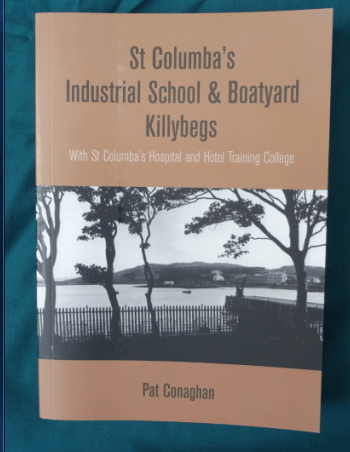
You couldn’t get a better present than this. Available at the Killybegs Information Centre on Shore Road, Four Masters Bookshop, Donegal, Eason’s, Letterkenny.
It is already known that the new town of Killybegs was founded by Charter of King James VI, dated 14th December 1615, in the 13th year of his reign.
The man chosen to build the new town was Roger Jones, then Sheriff of Sligo. Jones was a wealthy merchant and he was ordered to finance and oversee the building of the first houses in new Killybegs. The plan was that the king, who was always strapped for cash, did not have to spend anything on this new settlement. The town was managed by Jones and a group of picked gentlemen, who set themselves up as the Provost and Corporation of Killybegs, thereby giving (English)) legal status to the town. Jones was made Provost, and it is known that he occupied one of the first houses, although the site has not yet been identified. Jones had been granted a narrow plot of land for the town, adjoining the north shore of Killybegs harbour. This site extended from the ‘Bridge River’ eastward to the second by-road beyond the Commons School. A dispute over the ownership of this land meant that Jones departed Killybegs some years later, and he died in Sligo in 1637.
He was buried in St John’s Abbey, Sligo, and an elaborate gravestone, depicting Lady Jones and himself, was placed on his grave. Unfortunately the graveslab was badly damaged at a later date, and part of Jones’s image was lost. The fragmented stone is located today in the Cathedral of St Mary the Virgin and St John The Baptist, in Sligo.
While Jones, through his business interests, helped to establish Sligo town as a large trading centre, he appears to have had no influence on the development of Killybegs.
The priceless assets of a deep-water harbour and an abundance of fish were exploited by foreigners who used Killybegs as a base for fishing and processing. Government agencies such as the CDB, SFA, BIM and the IDA, supported the development of the industry for most of the 20th century. But it was not until private investors took control of the economics of the industry that the prosperous town of Killybegs emerged from the industrial darkness of the North West.
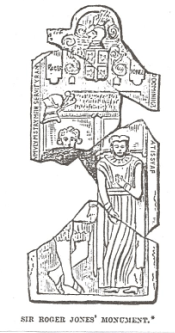
THE BROKEN GRAVE-STONE DEPICTING ROGER JONES AND HIS LADY.
It would be appropriate if a memorial to Roger Jones were to be commissioned and erected in Killybegs at this time, using a modified version of the above stone.
TOURISM
An article in the Press in 1929 described Killybegs as a great tourist destination. One of the sights to be seen, it was said, was the Rocking Stone in Faiafannon:
The Rocking Stone of Faiafannon, about two miles from the town, should not be missed. The huge stone, delicately poised on a rock, is capable of being moved without the slightest danger of being disturbed from its resting place. Strangers may have difficulty in providing the motion, but those who are familiar with the stone usually succeed in producing the swaying movement which gives it its name.
During the depression years of the late 1930s there was very little employment in Donegal. Work was created by the Government via Minor Relief Schemes, for example, the opening of extra roads in country areas, or repairing roads that did not really need much repair. One such scheme was started in the townland of Faiafannon, where, in November 1938, thirty men were provided with work, under the supervision of John McBrearty, Island. The purpose of the scheme was to build a new road to the Rocking Stone, or Wishing Stone, as some called it. Killybegs folklore stated that Finn McCool threw this rock from Connaught, although what made him so mad is not recorded. The new road was completed just before Christmas in that year, the scheme providing many households with badly-needed cash during the darkest time of the year.
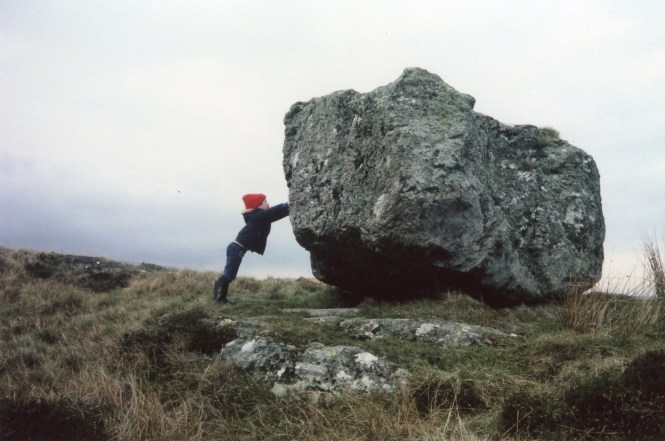
The Rocking Stone at Faiafannan, Killybegs.
THE HOMECOMING OF PATRICK DORRIAN AND HIS BRIDE
A very pleasant scene was witnessed in the town of Killybegs on Thursday night, 15th January last, when Patrick and Mrs Dorrian returned to their home after a protracted wedding tour. Mr Dorrian is well known in the north-west, as the respected senior partner of Dorrian Bros., Killybegs. When the date of the homecoming was made known in Killybegs the inhabitants determined to give their popular and patriotic fellow townsman and his charming bride a reception worthy of the respect and esteem in which they are held. Willing hands soon provided the material, and long before the train was due, many huge bonfires were in readiness awaiting the match. Headed by a band, the crowd adjourned to the railway station, and there awaited the happy young couple’s arrival. As the train steamed into the station amid an explosion of dozens of fog signals, the discharge of firearms, and the deafening cheers of the crowd, the scene was one long to be remembered. On alighting from the carriage, Mr and Mrs Dorrian were the objects of fresh outbursts of cheering, again and again renewed. It was a considerable time before anything like order could be restored. However, at last a start was made, the happy couple leading the way and the band following playing enlivening tunes, accompanied by a number of torch bearers and fully three hundred townspeople, each one bent on showing the esteem and popularity of Patrick and Mrs Dorrian and their approval of the of the reception accorded them. On arrival at the rooms of the Catholic Young Men’s Association, of which Mr Dorrian is the president, the members turned out en masse, cheers were given again and again, hats and handkerchiefs were waved, and amid the singing of He’s a Jolly Good Fellow, they joined the procession, and all continued the way to the residence of the bride, where Mr Dorrian, in a few well chosen words, returned the thanks of himself and his popular bride for the reception given them. He said that words failed to give adequate expression to his sentiments, but he could promise that it would be long before the events of that night would pass from his memory. His remarks were greeted with ringing cheers and shouts of Your are worthy of it. Refreshments on a liberal scale were provided, and while the people were enjoying the good things the happy couple moved about among the guests, receiving the congratulations and good wishes of all present, a choice selection of music being meanwhile rendered by the string band. About ten o’clock the crowd quietly dispersed to their homes, well pleased with the way in which they had spent the night. It is worth mentioning that the rooms of the CYMS, as well as most houses on the route from the station, were beautifully illuminated with coloured and other lights. (19 January 1903)
ST CATHERINE’S WELL TODAY (1955)
The Holy Well of St Catherine, situated on the side of a conical hill on which stands the ruins of Kit’s Castle, once the residence of the bishops of Raphoe, is still a place of daily pilgrimage. The sparkling water gushes from the limestone rock, and forms a pool which, overflowing, trickles down the hillside to the sea. There, on November 25th – St Catherine’s Day – the people of Killybegs and neighbouring parishes come from dawn to midnight in a constant stream, to pray. They climb the hill, and move reverently round the well, deisealach, doing the turas, rosary in hand. They sip the water that was blessed by some holy men in homage to St Catherine perhaps fourteen centuries ago.
(Written by Charlie Conaghan, in the Donegal Democrat, 20 February 1955)
TO BE LET, furnished, Croaghlin House, Killybegs, containing Drawing-room, Dining-room, Five Bedrooms, Kitchen, Pantry, Garret. Beautifully situated close to the Sea. Excellent Bathing. Within a Mile of Killybegs Railway Station. Terms Moderate. Apply to the Rector, Industrial School, Killybegs. (9 May 1902)
DONEGAL ASSIZES – CROWN COURT
Michael Gillan stood indicted for shop-lifting in Killybegs, March 1840.
Majee Driscoll sworn as witness – keeps a small shop in Killybegs; there are some wooden panes in the window; they were forced in at night, and a quantity of her shop goods taken away; saw the goods afterwards.
Sergeant O’Brien sworn as witness: Found the goods at Ardara and other places where the prisoner brought them to.
Guilty. To be transported [to Van Diemen’s Land] for ten years.
In the days before RTE we had to watch a lot of snow on the TV screen. Jack Murchan’s telly, when he lived up in the Braes, had a miraculous picture from UTV, but in the town all you had was a faint shadow behind the snow. We told ourselves that the snow was beautiful – what else could we do? Before that Paddy Sharkey had rigged up a TV in his house on Conlin Road. This report from the Democrat of 14 August 1953 recorded the historic occasion:
Mr Patrick Sharkey, wireless and electrical engineer, has installed a television set at his residence, Conlin Road, Killybegs. Apart from a little fading out at times, results are considered satisfactory.
 killybegsbooks
You must be logged in to post a comment.