Captain/Senator James McHugh

Interesting to see the February 1 post on TYFK and the link to the obituary of James McHugh. He was ‘born in Killybegs’ in about 1835, and died in the U.S in 1903.   Some of his great- great grandchildren may still be alive there.  There are no birth records going back to the 1830s that would indicate exactly where James came from.  There were seven McHugh households in the parish of Killybegs in the early 1830s, including the premises where Hegartys’ Spar store is now located on the Diamond.  On the other hand, McHugh may have come from Kilcar, as Killybegs was the Post Town for Kilcar back then and many Kilcar people gave Killybegs as their address.  The name was very often written as ‘McCue’ in the old days, and was very prominent in Kilcar, especially in the townlands of Croaghbeg and Muckross.  Anyway, James got on well in America, as the obituary below makes clear. The American Civil War is very well documented, and a lot of detail about the battles in which McHugh fought can be Googled.


FUNERAL OF CAPT. McHugh.   Services to be held at the Church of SS. Peter and Paul tomorrow.  The funeral of James McHugh, who died on Saturday night at his home, Meridian and Twenty-second streets, after two weeks’ illness, will take place tomorrow at 9 a.m. The funeral service will be held at the church of SS Peter and Paul.

He was born in Killybegs, County Donegal, Ireland, sixty eight years ago. He emigrated to this country in 1854, and after a brief sojourn in New York, came to Indiana, settling in Terre Haute.  From that place at the breaking out of the civil war, he enlisted as a private in Company A, Thirty-fifth Indiana Volunteer Infantry, the Irish regiment.  He served four years and two months and came out of the service with the rank of captain, gained by gallantry in the field.  He was made second lieutenant for gallantry at Stone’s river; first lieutenant at Chickamauga, and captain for noted service in the Atlanta campaign.  At the close of the war he settled in Indianapolis and married Miss Elizabeth Burns, who, with one son, William Todd McHugh, survive him. Shortly after their marriage, Captain and Mrs McHugh engaged in the millinery business in South Illinois street.  This business continued until six weeks ago, and in it they acquired a competency.  In 1882 Captain McHugh, who had long been recognised as a quiet but effective Democratic leader, was elected a member of the Indianapolis Board of Aldermen, and in 1892 was elected a State Senator from Marion county.  IN 1893 he was appointed by Governor Matthews one of the commissioners to assist in locating the position of Indiana troops on the field of Chickamauga.   In recent years Captain McHugh had travelled a great deal, both in this country and in Europe. He spent several summers in Donegal, where he took great interest in yachting in Killybegs bay, and was known as the American commodore from the fact that he always flew the American flag from his yacht.  (Indianapolis News, 21 December 1903)

This below is from another paper:

SENATOR McHUGH DIES SUDDENLY AT HIS HOME.Born in Ireland, Prominent in Political Circles and Held Many Offices of Trust.AN EXTENSIVE TRAVELLER, Senator James McHugh died last night at 7.45 at his home on Meridian and Twenty-second streets, of haemorrhage of the stomach after a lingering illness of two weeks. Senator McHugh’s death was quite unexpected for a few minutes before his demise he was talking with the members of his household gathered around his bedside and appeared in best spirits.  Senator McHugh was born in Killybegs, Donegal, Ireland, and emigrated to this country, landing in New York.  After remaining in that city a short time he came West in obedience to the advice of Horace Greeley and after travelling through the West for some time, Senator McHugh settled in Terre Haute, Ind.  Mr McHugh enlisted as a private in Company A, Thirty fifth Indiana Volunteer Infantry, and served throughout the war, winning for himself a great name as a valiant and brave fighter.  At the close of the war he came to this city to reside and shortly after married Miss M. Burns.  Senator and Mrs McHugh opened up a millinery store on Illinois street, which was operated until about six weeks ago. He was planning a trip to the Philippines and the Hawaiian Islands at the time of his death.  Surviving him is his wife and one son, William Todd McHugh.  (Indianapolis Journal, 20 December 1903)

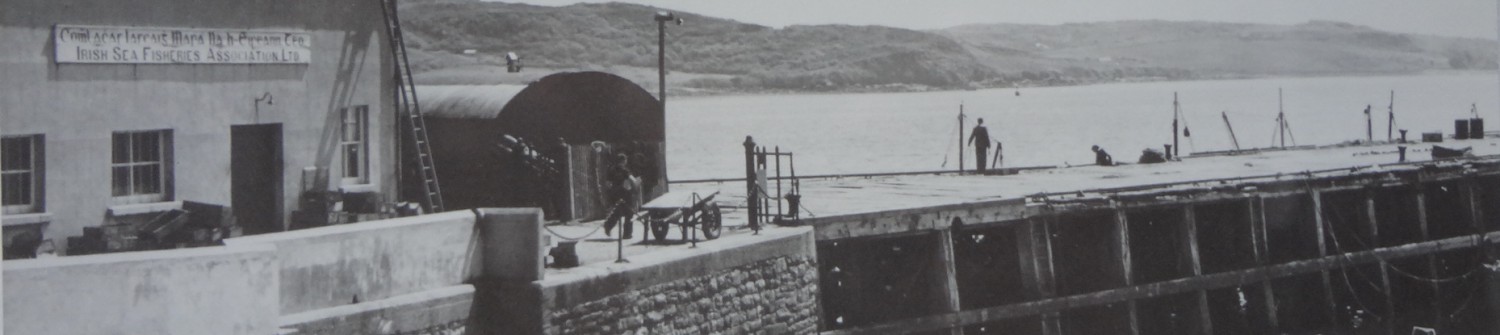
 Captain McHugh is recorded as a judge on the Flagboat at Killybegs Regatta of 1897. He was present again at the 1900 Regatta, where he was Vice-commodore and also a judge.  His yacht, Fusilier, came third in one of the races, but it is not known if he sailed himself. His last visit to Killybegs was for the Regatta of 1902, when he was Vice-commodore and also a judge of the yacht races. On the day before this Regatta, young Hugh Cunningham of Spout Street was drowned from his boat while sailing in the harbour.  As a result, no Regattas were held for several years.
Poem (2)

This poem by James Conwell of Killybegs was published in Bygones:

Oh, there’s Diana rising over Carn, full

And on the town of Killybegs her golden light she spills,

Reflecting in the harbour St Mary’s on the hill,

A monument of olden days of faith and hope and skill.


Stars are winking earthwards; all is calm and still

Save music sweetly flowing from every brook and rill.

Troutlets ring the crystal pools above their umberbeds

And wild ducks haunt the bracken on the borders of Lough Head.


Across the spawn that reaches to Benroe,

From out the purple heather the Moorcock loudly crows;

The cuckoo sweetly calling from the tree tops ever green

And the corncrake is mimicked from Brookhill to Carnaween.


‘Tis sweet to gaze on Croaghlin when fading from your sight

And sweeter when illumined by the Rotten Island light;

The waves that dash along its base, they hail from Drimanoo,

They spend their force at Roshin and return full charged anew.


There’s music in their dancing, seems a host of angels sing,

Then lustral dews are falling and the Angelus bell it rings;

There is romance in the stillness and a seeming fairy spell

Through the vista near the Rectory and around St Catherine’s Well.


There’s a dullness creeping o’er me, and I must seek repose;

For tonight I will be dreaming e’er my sleepy eyes they close.

Of tomorrow in the offing, and the sunshine on the crags,

Reflecting in the harbour and the church and Killybegs.


Dawros Fund Subs.

On December 11th, 1902, Cornelius Cannon was drowned from the yawl Shamrock at Rosbeg, leaving a wife and two small children.

A Disaster Fund was established, and the subscribers’ names were published. An account of the disaster can be found in The Zulu Fishermen, where the first round of subscribers is printed.  Below is an additional list of subscriptions from the Killybegs area:

DAWROS BAY FISHING DISASTER FUND.

ADDITIONAL SUBSCRIPTIONS.

Collected by Miss Bridie Quinn, Killybegs.


Very Rev Canon Sweeney, P.P., Killybegs £0 10 0
Rev Michael Ward, C.C., Killybegs £0 2  6
Charles Rogers, Esq., J.P., Killybegs £0 10 0
Captain Gunn, R.N., Killybegs £0 2  6
Captain Coleman, R.N., Killybegs £0 2  6
Mr Patrick Quinn, Killybegs £0 10 0
Mrs P. Quinn, Killybegs £0 10 0
Mr Michael Murrin, Croaghlin £0 10 0
Mr Patrick Boyle, Curraghfeighan £0 5  0
Mrs P. Boyle Curraghfeighan £0 5  0
Mr James Murrin, Killybegs £0 5  0
Miss Bridget Harkin, Killybegs £0 2  0
Mr Daniel Quigley, Killybegs £0 2  6
Mr John McGarrigle, Killybegs £0 2  6
Mr Frank Rogers, Killybegs £0 2  6
Mr P. A. Mulreany, N.T., Killybegs £0 2  6
A Friend £0 2  6
A Friend £0 2  6
A Friend £0 1  0
Mr A. McGrory, Benroe £0 2  6
Mr Peter Cannon, Glencolumbkille £0 1  0
Mr Thomas McKee, Malinmore £0 1   0
TOTAL £4 15 0

FRENCH [BOATS] ARRESTED

At Killybegs Petty Sessions on Monday, 10th October 1921, Mr Byrne, the Officer of Customs and Excise, charged Jean Yves Kergrouch, master of the Lugger, Marie des Anges, and Jules Maria Meleree, master of the Lugger, Turenne, that they did fish in the neighbourhood of Killybegs, within the exclusive fishery limits of the British Isles.  The Luggers were arrested off Malinbeg by H.M. ship Newark. Lobsters were discovered on board; a boat was seen returning to the Turenne, loaded with crab pots.  The Court fined the captain of each Lugger £5, with £5 costs, and ordered that the lobster and crab pots of each vessel be forfeited.

(The HMS Newark was an armed twin-screw minesweeper, built by A & J. Inglis on the Clyde, and launched in June 1918)

Marriages (1)

January 29, 1903, at the Catholic Church, Killybegs, by the Rev Canon Sweeney, P.P., James Brennan, Crucknasharra, to Bridget, daughter of Mr Pat McLafferty, Largy, Killybegs.

November 24, 1849, at St John’s Church, Killybegs, by the Rev William Lodge, Louisa, daughter of the late James Hamilton, Esq., Fintra House, Donegal, to Lieutenant J. B. Cater, R.N.

September 30, 1870, at St Mary’s church, Killybegs, by the Rev Mr. Stephens, P.P., Mr John Dunne of H.M. Revenue Cruizer, FLY, Killybegs Bay, to Mary Jane, eldest daughter of Capt. James McBrearty, Schooner FASHION, Killybegs.

June 15, 1937, at Pinslip R. C. church, Middlesex, Nurse Catherine Agnes Murrin, second daughter of Thomas Murrin Drumanoo, to Daniel McNern, Cashelogary, Inver.  Given away by her brother, Patrick.  Bridesmaid: Mary Murrin, sister; Best man: Thomas Murrin, brother.

Poem (1)

The late Bella McGee, New Row, Killybegs, often sang at local concerts during her earlier years.  In later times she turned to writing poems, which she often sent to the U.S. where they were published.  Here’s one that was to mark St Patrick’s Day, 1950:

          TO AN EXILE.

If I could send a piece of soil

Of the dear old land to you

I would plant a dear wee

Shamrock

Wet with Irish dew.


I would send a breeze of Shannon

air,

A drop of Killarney’s lakes

A piece of heather from Donegal,

To plant there in the states.


It would be little Ireland to you,

A place you could call your own,

With a little old thatched cottage

Just like ‘Home Sweet Home’.


With a spinning wheel outside the

door

A rick of turf close by.

Sure it would be a piece of Ireland

Beneath the U.S. skies.


O, if I could do these wonderful things

How happy I would be

To send a piece of Ireland

Across the Atlantic sea


I would be pleasing many an Irish

heart

Who once left home to roam

The United States of America

Far away from their Irish homes.


As an Irish girl I send this greeting

It’s all I can send to you.

May God bless all the Irish hearts

The Irish hearts so true.

Fox Wars

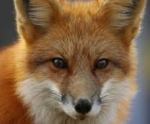
FoxThis report appeared in the local papers in December 1943:

Putting up speed on sighting a huge fox on the railway line, on a recent morning, Railbus driver Michael Lafferty ran down and killed the animal near Bruckless. Renyard weighed 6 stones. [84 pounds, or 38kg]

That report would have brightened up the day for those people who kept hens and geese in the local area, because, for them foxes were a deadly enemy.

When we entered the ‘modern’ age in, say, the 1960s, most people who had kept hens, ducks, geese, etc., gave up that activity. Supermarkets made oven-ready chickens universally available, as well as eggs off the shelf.  One of the great downsides of keeping fowl at home was the danger of foxes raiding the henhouses and killing every bird in sight.  It could be said that those well-stocked fowl-houses were to the foxes what the supermarkets were to the housewives. Ready-made meals at your fingertips (or claw-tips).

Foxes not only raided outlying farms, but also entered town fowlhouses, even in broad daylight. The County Council offered a bounty of five shillings for each adult fox killed, but the amount of funding allocated for this never satisfied those who lost fowl year after year. In 1939 Mr Brady, the Chief Agricultural Officer for Donegal, said the number of foxes killed in the county up to the 1st May under their scheme were 111 dogs, 80 vixens, and 235 cubs, making a total of 426.  The result was that of the £100 allocated for the scheme, only £22 7s. 6d. remained and that would very soon be used up.

But, the killing went on:

In November 1937 a fox killed five ducks in one raid at the farm of James McCullagh, Stragar, Killybegs. It was making a meal of the fifth when discovered.  It made good its escape.  

 And they attacked if cornered:   John O’Boyle, an octogenarian, of Glencolumbkille, was severely bitten by a large fox which entered his fowlhouse in the early hours of Tuesday 19th October 1937. He heard the commotion in the house, and saw two huge foxes devouring his chickens.  While trying to intercept them, one of the animals badly lacerated his hand. 

 Local committees were formed, and fox-hunting clubs sprang up in almost every town in Donegal.  The Killybegs Fox-hunting Club of the 1940s was well organised, and held an annual dance to raise funds. The keeping of fowl provided an additional farm income, and in town it was common to keep hens.  In the country areas especially, foxes raided frequently, and were actively hunted:

A large mountain fox which was held responsible for the destruction of a large number of fowl in the Ballydubh district of Kilcar, was rounded up by a large number of men and dogs and dispatched on the evening of Sunday 22nd May 1938.  It was pursued to its lair, which was stuffed at each end.  The men dug until the fox was reached, chased out, and killed by the dogs.

In Killybegs parish in August 1940, heavy losses of fowl were sustained by Michael Gallagher, Faiafannon (three dozen hens in one night); Tom Blaine, Drumbarity (eight turkeys); James McGuinness, Meenahooghan (twelve ducks), and Hugh McIntyre, Croaghlin (ten hens).

While out hunting in Darney in June 1941, a dog, the property of W. Henderson, Ballyloughan, killed two large foxes, bringing the total number of foxes accounted for by this dog during the past three years, to eighty five.

A public meeting about the fox menace was held in the Foresters’ Hall, Killybegs in mid August 1941. Hugh Callaghan, Conlin, a local Co Councillor, criticised the Killybegs Parish Council for failing to take steps to prevent the spread of foxes, which had become exceedingly common during the past six months.  Councillor Callaghan proposed that the military, then garrisoned in the Industrial School in Killybegs, be asked to attack the foxes’ lairs in the district.  At a follow-up meeting on August 24th, Captain Kelly, Officer commanding the 17th Battalion in Killybegs, replied that he could do nothing until he received clearance from Army HQ.

The men of the Local Defence Force volunteered their services. Group Leader Daniel O’Donnell said that the LDF were quite willing to do all they could to assist in the campaign for the extermination of the foxes and they were prepared to begin at once if supplied with ammunition. (they already had rifles). It was considered more advisable to use shotguns, and the committee decided to supply the cartridges.

But the foxes continued to make their guerrilla attacks:

Foxes have wrought great havoc [in the last week of 1941]. Eighteen hens disappeared from one farmhouse in Conlin.  The local committee in charge of the campaign against foxes is making arrangements for laying poison for the marauders.

 Who won the war? It could be said that the domestic fowl have since then all but disappeared, while the foxes have found other means of survival.  The ‘war on foxes’ seemed to be at its height during the Second World War, when everything was in short supply, and people had to protect what resources they had.  It was a time when many farmers suffered financial setbacks they could ill afford, during those years of depression.  Even though the men and boys with their guns and dogs enjoyed the excitement of the kill on those summer Sunday evenings.

The Demon Drink


beer.jpg


The first meeting of the Killybegs Church Temperance and Christian Association was held at Largy in February 1886.

The Rector of Killybegs, the Rev John G. Ball, took the chair, but nothing is known about that first meeting. A year later, on 9th February 1887, the annual meeting was held in the Murray Lodge schoolhouse on the Donegal Road.   The room was decorated for the occasion with flags, evergreens, and mottoes by the Coastguard Station officer, Mr Bailie.  The decorations in use were the Coastguard signal flags.   There was such a crowd that many had to stand outside the building.  The Rev Ball was absent from this meeting due to his advanced age and infirmity.  [He was 87 then]. The annual report was read by Thomas C. Hope, the manager of the Ulster Bank.  He said that, at the first meeting, 26 people had enrolled in the Association, and since that time they now had 120 members.

Very successful meetings had been held in Largy, Roshin, Aughayevoge, and Carricknamohill during the year. It was remarked that the Association was formed in the districts near Killybegs, but not in the [town], ‘for no house was available’.

The Rev W. Hunt, Killymard then gave a lecture on The Drunkard’s Home, illustrated with magic lantern views.  The remainder of the pleasant entertainment consisted of songs by Miss Ball, Miss Hope, Mrs Chapman, and Miss Chapman. The meeting closed after a hymn with the benediction.

A year later the Association was known as The Killybegs Church of Ireland Temperance Society. They held their next meeting on Friday 2nd March 1888, in Largy, but the location is not stated.

“Shortly after five o’clock tea was dispensed. The meeting was open to the members and friends without any charge, owing to the kindness of Arthur Brooke of the White House, Killybegs.  A nicely-arranged programme was then gone through.  Song, No Drink Like Tea was sung by Mrs Chapman and Miss Hope.  The hon. secretary (J. C. Hope) read the report, which was moved by Blain Watson, and seconded by Thomas Gartley, and showed that during the past year no less than seven members had left this country for America, and six to other parts, yet still the society was progressing in all the districts of the parish.  The appointment of officers and committee for the ensuing year was moved by A. Watson, and seconded by J. Watson, Jun.  The chairman, Rev A. Chapman, addressed those present on the evils of intemperance.  The song, Touch not the Cup was then sung.  I’m such a very nice little Girl was recited by Miss Lily Chapman, a girl of five years.  Some amusing readings were given by J. C. Hope, after which Miss Hope and Mrs Chapman sang When ye gang awa’ Jamie, which was warmly applauded.  A very touching story, illustrating the difference between the home of the drunkard and of the sober man, was read by the chairman. Trust in God and do the Right, being sung, Thomas Porter, Dunkineely, gave a very able and suitable address, which was listened to with rapt attention.  Songs were then contributed by Mrs Chapman and Mr and Miss Hope, which received warm applause.  Medals were awarded to those who had helped at the monthly meetings during the year. A vote of thanks having been moved by Mr Porter, and seconded by Mr Gartley, to the friends who assisted in the entertainment and also to Mr and Mrs James Watson for the kindness in placing their house at the disposal of the society, the proceedings were brought to a conclusion by singing Where are the Reapers, and the benediction”.


KILLYBEGS HAS A ‘NEW’ TOURIST ATTRACTION.

murillo


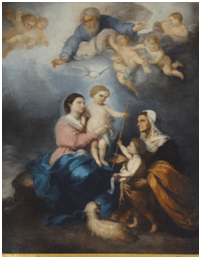
In the old days distinguished people came to Killybegs to see the tomb slab of Niall Mor McSwyne and a 17th century painting of the Holy Family in St Mary’s church.  Now the church has a new attraction in the form of the restored painting. It is in the style of the famous Spanish artist, Murillo, although not by the master himself.  The restored painting was unveiled in a special ceremony on Friday 16th October, 2015.  The original work by Murillo is in the possession of the Louvre in Paris, where it is titled The Holy Family, or The Virgin of Seville.

The Killybegs painting was presented to Father Drummond for his new church in Killybegs at some time in 1844 by Alexander Murray, the most extensive landlord in the district.

The story of the picture that has come down to us is very sketchy, but its time in Killybegs can be reconstructed.

Murillo’s large religious paintings were intended to be hung in churches or in the palaces of Bishops, so the Killybegs copy was painted for the same reason.

Apparently Murray bought the painting in London for 200 guineas, and sent it to Dr Drummond who hung it in the newly built church. It appears that everyone, including Murray, knew that the painting was executed by someone other than the master himself, and from that time at least there was no question of anyone being deceived. Landlords in Ireland have had a very bad press, but, in Murray, Killybegs surely had one of the best.  This article is too short to list all his contributions to Killybegs, but it must be said that he provided the site for St Mary’s (and St John’s) church, as well as a donation of £100 towards its construction.  The Mulreany family used to cut the hay on this site but it is likely that Murray provided them with another piece of ground.  Murray was well known as a collector of art, and it is curious that he should have paid such a large sum for a painting that was not an original Murillo.  No doubt Father Drummond was delighted at such an impressive gift for his new church.  But how much more pleased would he have been if Murray had sent him 200 guineas in cash?  Especially so because Dr Drummond had to travel to America to raise the money to complete the church. (From the Irish community there, and not by singing on street corners, I beg your pardon). Dr Drummond went across the Atlantic in the Paddle-steamer, Britannia, that carried the ship’s cow in a deckhouse.

Not having access to the finding aids of today, Dr Drummond and his advisors interpreted the painting as The Visitation, and named the new church accordingly.  By 1856 Dr Drummond’s former Curate, Father James Stephens, then parish priest of Taughboyne, was still calling the painting The Visitation of the Blessed Virgin.  The painting depicts St Elizabeth and John the Baptist paying homage to the Child Jesus and Mary, His mother, so his early title was descriptive enough.

It was not until he returned to Killybegs as parish priest that Father Stephens stumbled on the ‘correct’ title of the picture. In 1867 he decided to erect, within the church, memorials to Bishop Donald McGonagle, and to Dr Drummond, the church’s founder.  He erected a stone tablet on the wall near where Dr Drummond’s remains lie (unmarked), and installed a stained glass image in one of the triplet windows over the high altar.  This was a representation of St Catherine of Siena, to whom Dr Drummond was especially devoted.   At that time the Murillo painting was hanging on the chancel wall, over the high altar, and it was taken down to facilitate the work on the St Catherine of Siena window.  Apparently the picture was then in poor condition because Father Stephens sent it off to Lesage’s in Dublin to be restored. Among those who were publicly acknowledged as having contributed (usually £1) to the restoration fund were the Right Hon. Chief Justice Monahan, Joseph Woodstock, Dublin, Simon Sheil, M.D., Ballyshannon, and Patrick Donnelly of Omagh.  Donnelly’s wife was Ellen Coane of Coane’s Hotel, Killybegs, now the Cope House.  The Coanes were closely involved in parish affairs at that time, and it was most likely that it was Ellen who prompted the donation. In the 1940s Ellen’s son, Alex Donnelly, a solicitor by profession, kept the old Hotel going during its last years in the family.

The restored painting arrived back in Killybegs at the end of 1867. Father Stephens invited the Very Rev James McDevitt, Professor of Philosophy at All Hallows college, to give the sermon at a special Mass on December 22nd to mark the occasion. Dr McDevitt would go on to be consecrated Bishop of Raphoe in 1871.

Among the distinguished visitors to Killybegs who went to see the painting in 1880 was Hugh Childers, the British Secretary for War. He was received by Father Stephens in the old parochial house on Chapel Lane, in September of that year. After their discussion, Childers, with his wife and daughter, viewed the interior of St Mary’s, and were particularly struck with the splendid painting of the Holy Family. It is interesting that Childers’ daughter, Milly, then only 14, later became a painter of church interiors, copyist and restorer.

Canon John Sweeney had the church renovated when he was P.P., when the painting was probably taken down, at least for a time. Then, in May 1936 work on the repair of the ceiling of St Mary’s was begun, and it is likely that this was the time when it was put into storage for the last time.

So, just like the old days when tourists came to see both the grave slab of Niall Mor and the ‘Murillo’ painting, they can be seen once more.